Start building

Your year-end donors are ready to stay. Give them a way.
Five steps to a monthly giving program

"Monthly Giving Builder made the work feel possible again."
- Sydney Zetune, Executive Director, FEAST




Listen to The Podcast for Marketers Looking to Amplify Their Online Presence
Missions to Movements Podcast
Search the Blog
Blog Categories
I believe positive stories of change can transform our world to be a better place. That’s why I teach nonprofits how to use social media ads to attract potential supporters to their cause and create sustainable giving models by building monthly giving programs for everyone to become a philanthropist.
Hey, I'm Dana Snyder!

Reading Time: 10 minutes
LISTEN ON APPLE | LISTEN ON SPOTIFY
This episode is brought to you by GivingTuesday! GivingTuesday is a global generosity movement that started in 2012 with a simple idea: a day to do good.
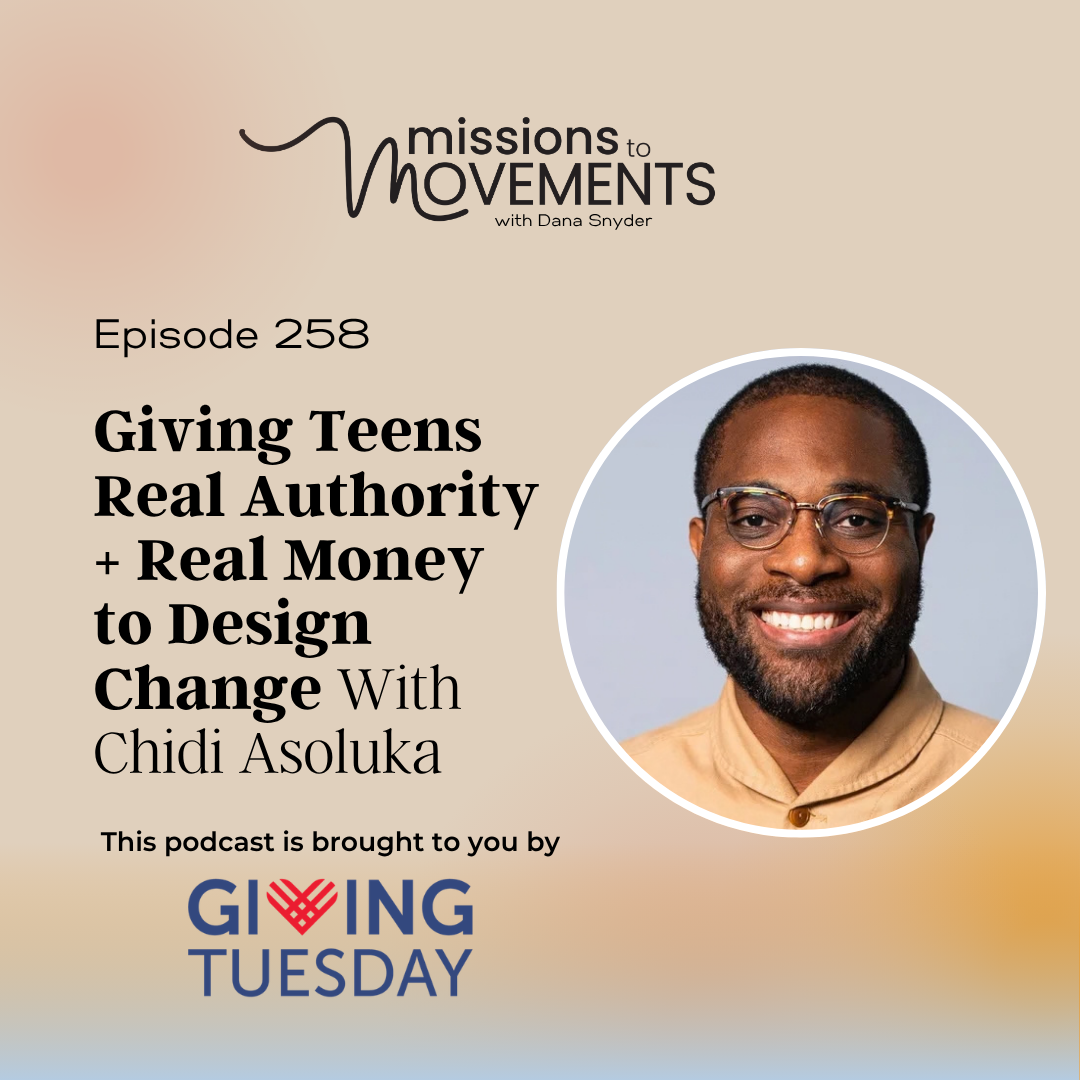
Giving Teens Real Authority + Real Money to Design Change with Chidi Asoluka
Imagine handing a high schooler a real $10,000 budget. I mean a real budget, with real authority to spend it on a real problem in their own neighborhood.
For most organizations, that idea would get shut down in the first meeting. (“No, no, no, they can’t actually be responsible for that.”) For my guest on this special in-person episode of our nonprofit CEO series, recorded right here in Atlanta, it’s just how things work.
I’ve been thinking a lot about youth voice in nonprofit leadership lately, and about the difference between giving someone a seat at the table and giving them a meaningful seat at the table. Chidi Asoluka has built an entire organization around that difference. At NewComm, high school students manage real budgets, sit on the junior staff, and help steer the organization’s decisions. That approach has grown NewComm from 11 students to more than 150 in four years. Y’all, I am obsessed with this conversation.
Who Is Chidi Asoluka?
Chidi Asoluka is the founder and CEO of NewComm (short for the New Community Project), a civic design studio where high school students from historically marginalized communities build real solutions for their own neighborhoods, backed by real budgets and real decision-making power.
Before founding NewComm, Chidi spent 16 years as a classroom teacher. His own journey runs from Newark to Georgetown University, and NewComm began as a single English elective in Philadelphia. Today, NewComm serves more than 150 students in the Bronx and is expanding into Brooklyn this fall.
The question at the center of his work is one he keeps putting back to the entire sector: Who actually gets to design change?
The Banker Who Was Supposed to Be a Teacher
I love that Chidi never wanted to be an educator. He actually pitied his teachers for having to manage rowdy teenagers. (He admits he was one of them. Honestly, we all were.)
As the child of immigrants, success meant becoming a banker, a doctor, a lawyer, or an engineer. So while he was deep into Toni Morrison, James Baldwin, and writing his own poetry in college, he was also interning at a bank for four years. He planned to be a banker who also liked poetry.
Then came his final interview for a full-time role. After all the standard questions, the interviewer asked whether working at the bank would make him happy, or whether developing something that could change the world would.
He thought it was a trick question, so he said the bank. She looked him square in the eye and said, “I don’t believe you.” She told him he’d make a great banker, but an extraordinary educator. The job was his if he wanted it, but she wanted him to apply to teach first. She also said she had a funny feeling he wouldn’t remember her name.
He doesn’t. He’s been teaching ever since. And I am so thankful that banker didn’t let him become a banker.
How a Dream About Toni Morrison Became NewComm
Even in the classroom, that phrase kept ringing in his head: develop something that can change the world. Helping students conjugate verbs and prep for the SAT didn’t feel like that.
Then one night, he had a dream. Well-dressed students walked into the White House, each holding Toni Morrison’s Song of Solomon, and presented policy they’d built from chapter eight. The president opened the book too and said, “All right, let’s do that.”
Chidi woke up with a new idea. Literature had always mattered to him, but he’d never thought of it as the source code for social impact. The same way producers sample old soul records, students could sample literature to understand systems and design solutions.
He walked into his principal’s office that day and asked to teach something brand new, even though he couldn’t fully explain it yet. His principal said, “I don’t understand, but try it.” (Can we all take a moment for leaders who say yes before they fully understand? Without that yes, none of what came next happens.)
That class became the New Community Project, or NewComm: an English elective that paired literature with nonprofits tackling big challenges in Philadelphia. Students raised money selling T-shirts and ran free yoga and dance classes, food drives, website redesigns, and even an urban gardening course. Applications poured in.
Chidi eventually set out to grow NewComm from a class into an institution, specifically a Black institution where students could study literature and data differently because the learning was immersed in community. He started recording himself on YouTube. That led to a TED Talk, which led to seed funding for a summer program with 11 students. Eleven became 50, then 100, and now NewComm is in its fourth year.
The Act of Generosity That Started It All
When I asked Chidi whether that seed funding was the life-changing generosity he often talks about, he said no. It goes back much further.
In high school, Chidi was set on Georgetown. He’d never visited the campus, but he told everyone that’s where he was going. When a letter arrived from Georgetown’s financial aid office asking for documents, a friend took it as an acceptance and announced it to the whole school at morning meeting. The room erupted. Chidi was mortified because he hadn’t actually gotten in.
Sitting in that meeting was Charles Cawley, founder and CEO of what was then MBNA America Bank and a Georgetown alum himself. Later that day, Chidi was called out of calculus to the principal’s office, certain he was in trouble. Instead, Mr. Cawley asked him how he planned to pay for school. Chidi said he’d work three jobs if he had to, so his parents wouldn’t carry the burden.
Mr. Cawley told him that if he went to Georgetown, he’d pay for it. A moment later, he added that he didn’t actually care where Chidi went to school. He’d pay for it anyway.
He covered four years of tuition, books, food, everything. Chidi describes it as a generosity so tremendous that he feels called to give it back threefold. When you look at NewComm, you can see exactly where that’s going.
Why Success Shouldn’t Require Erasure
This is the part of our conversation I can’t stop thinking about, especially for anyone working in or funding youth programs.
Funders often want success to look neat and linear. Chidi has deep respect for the poverty-fighting work happening across the sector, but he sees a lot of it built on one simple framework: take poor kids, give them skills for high-paying jobs, and call it a win.
That framework misses the poverty of mindset that follows you into every room. Some people call it imposter syndrome, but Chidi is searching for language that goes deeper. It’s the constant voice saying, ” Let me make sure I don’t mess this up.
He also sees many organizations focused on cleaning young people up, teaching them which fork to use or coaching the slang out of how they talk. He grants there’s some merit to that, but he poses a direct challenge to the entire sector: “Why does success have to come with erasure?”
NewComm’s goal is to enliven curiosity rooted in who students already are, so they’re prepared for college and prepared to be themselves. That’s hard to capture on a tidy grant report, which is why Chidi believes funders need real relationships with the organizations they support. Those relationships are how you see the messy middle work that actually transforms lives.
What Youth Voice in Nonprofit Leadership Actually Looks Like
When NewComm calls itself a civic design studio run by high school students, it means it.
NewComm has a group of students called managing partners: seniors who’ve been in the program since freshman year and now serve as junior staff. They meet with Chidi every week for 90 minutes, and he is radically transparent with them about how the budget is doing, what he’s worried about long-term, and how the student body is doing overall.
The managing partners respond with their own ideas, and each one brings a “major,” a specific lens they hold in every conversation. Zay, one of the managing partners, focuses on increasing representation and support for young Black men. When the team talks about wellness, he’s asking how it affects that group specifically.
Because these students have real ownership, they take care of the organization. They mentor younger students. They’re the team’s eyes and ears.
Chidi credits NewComm’s growth over the past four years directly to this model. As I said to him, that’s a sign of respect. His hope is that students carry that feeling into every table they ever sit at.
This is what I mean by a meaningful seat at the table. I hope this conversation reaches somebody exactly where they are and inspires them to bring youth, beneficiaries, or whoever their organization serves into an actual leadership position, with the information and influence to make real change.
The Net Gala: A Fundraiser Built by Students
The Net Gala might be my favorite nonprofit event origin story ever.
It was the very first funded project from NewComm’s first cohort, who were given $10,000 to manage. The students had noticed a pattern: professionals would visit their school, share what they do, say something like “you too can be a doctor if you work hard,” and then go home. No lasting connection.
The idea came straight out of literature. While reading The House on Mango Street, students wondered what would happen if Esperanza had true mentorship, someone she could actually text with an idea and hear back from. In more privileged communities, that’s how opportunity works. Someone knows someone who knows an aunt who knows an uncle. The students wanted to build that kind of deep social network in their own community.
They wanted it to feel like the Met Gala: dressed up, buttoned up, a real occasion. Then one student raised a hand and said, “It’s right there. It’s the Net Gala.” The room erupted.
That first Net Gala brought 100 professionals to a networking party hosted entirely by students. It was so successful that it became NewComm’s annual fundraiser. I love that NewComm’s call for capital was born from students managing capital.
Campaigns was my favorite class in college, and NewComm is offering that kind of experience at an even younger age, with real money and real odds. If I were in high school, I’d be asking how to get in.
When a Yoga Studio Became a Place of Restoration
When I asked Chidi for a project that made him go “whoa,” he took us back to the early days in Philadelphia.
NewComm projects have clients: community organizations working on big questions affecting young people. In the Bronx today, for example, students are focused on healthy nutrition in neighborhoods where bodegas outnumber supermarkets. The very first client was a community partnership school relocating into a big glass building in Brewerytown, a neighborhood on the cusp of gentrification. The school wanted the community to know it was still for the community.
Students identified two classic markers of gentrification: yoga studios and Starbucks. So they got curious about what a yoga studio could mean for a neighborhood. They emailed and called the one opening nearby and asked to host free community classes there. The owner said yes, because she’d been looking for ways to build community.
Students promoted free yoga, meditation, and dance classes all summer through Facebook ads, flyers, and door-knocking. Every class sold out.
One woman came to every single session. Near the end of the summer, within earshot of the students, she told the studio owner that the classes had healed her. Her son had been killed the month before, and she hadn’t left her apartment since. Then she saw an ad for free meditation classes on Facebook. She’d never meditated a day in her life, but she took it as a sign from God that it was time to leave her house. She’d been coming faithfully ever since, and she could feel herself being restored.
For Chidi, that moment is NewComm in a nutshell. In his words, the goal is to ask, “How can learning be a space for community restoration and not just good SAT scores?” He hopes his students walk into the boardroom, the operating room, or the courtroom thinking beyond how to win, and asking how their work can restore what has been broken.
I still remember sending postcards to teachers I loved years after graduating. I can only imagine what it’s like for Chidi to hear from students years later about how NewComm shaped their careers, their families, and their lives.
How to Strengthen Youth Voice in Nonprofit Leadership
You don’t have to run a youth design studio to take something from Chidi’s work. If you want to strengthen youth voice in nonprofit leadership, or the voice of anyone your organization serves, start with sharing real information the way Chidi does with his managing partners, who see the actual budget and hear his real long-term worries rather than a filtered version. Trust grows when people have the full picture, and NewComm’s Net Gala only exists because students had both a real $10,000 budget and the authority to use it. If you’re a funder, that same principle applies to how you support an organization: build the kind of relationship that lets you see the messy middle work, the transformation that won’t show up on a tidy outcomes chart.
Maybe most importantly, remember the principal who said, “I don’t understand, but try it.” Sometimes the most powerful thing a leader can do is say yes before the idea is fully formed.
As the mom of a three-year-old, I hope my daughter grows up somewhere that treats her ideas like they matter. Chidi is building exactly that.
Frequently Asked Questions
What is NewComm?
NewComm (the New Community Project) is a civic design studio run by high school students from historically marginalized communities. Students use literature and data to understand community challenges, then design real solutions with real budgets. NewComm began as an English elective in Philadelphia and now serves more than 150 students in the Bronx, with expansion into Brooklyn.
Who founded NewComm?
NewComm was founded by Chidi Asoluka, a former classroom teacher of 16 years who serves as the organization’s founder and CEO.
How does NewComm give students real authority?
Students manage real project budgets, starting with $10,000 for the first cohort. Senior students serve as managing partners on the junior staff, meeting weekly with the CEO to review the budget and organizational concerns and to help shape decisions through their own areas of focus.
What is the Net Gala?
The Net Gala is NewComm’s annual fundraiser. It started as the first student-funded project: a Met Gala-inspired networking event where students invited 100 professionals to build lasting mentorship relationships.
Why does youth voice in nonprofit leadership matter?
When young people have real information, real resources, and real decision-making power, organizations make better decisions and grow stronger. Chidi Asoluka credits NewComm’s growth from 11 students to more than 150 directly to students having a meaningful seat at the table.
How can nonprofits involve young people in leadership?
Nonprofits can involve young people in leadership by sharing real information with them, giving them control over real resources, and inviting their perspective on actual decisions. Assigning each youth leader a focus area, as NewComm does with its managing partners, helps them bring a clear lens to every conversation.
Connect with Chidi Asoluka and NewComm
You can explore every project NewComm students have built at newcommproject.org and follow along on Instagram at @newcommproject. Connect with Chidi on Instagram at @iamchidi or on LinkedIn under Chidi Asoluka.
NewComm has an open door policy. If you want to see the projects in person and hear students describe their vision for restoring their communities, you’re welcome.
Resources & Links
This episode is brought to you by GivingTuesday! GivingTuesday is a global generosity movement that started in 2012 with a simple idea: a day to do good.
This year, on Tuesday, December 1, 2026, join the conversation: share your favorite nonprofit’s campaign, volunteer for a cause you care about, share an act of kindness, or encourage your audience to do the same.
Use #GivingTuesday, tag @GivingTuesday, and visit GivingTuesday.org/Participate to get involved and inspire others!
Connect with Chidi on LinkedIn and learn more about NewComm at newcommproject.org.
The Monthly Giving Builder is the only interactive tool that generates your entire monthly giving program with you, starting at $49.99/month.
My book, The Monthly Giving Mastermind, is here! Grab a copy here and learn my framework to build, grow, and sustain subscriptions for good.
Not sure where to start in building your program? Start with this audit to know where your gap is. Takes 5-10 minutes max, and you’ll know where to start –> Monthly Giving Interactive Audit
Want to make Missions to Movements even better? Take a screenshot of this episode and share it on Instagram. Be sure to tag @positivequation so I can connect with you.
ABOUT THE AUTHOR
Dana Snyder
Dana Snyder is the founder of Positive Equation, creator of the Monthly Giving Builder, a sought-after keynote speaker and workshop facilitator, and the author of The Monthly Giving Mastermind: A Framework to Build, Grow & Sustain Subscriptions for Good. She is also the host of the global nonprofit podcast Missions to Movements, and host of the Monthly Giving Summit, a worldwide event for nonprofit professionals focused on building stronger recurring revenue programs.
Leave a Reply Cancel reply
This site uses Akismet to reduce spam. Learn how your comment data is processed.

ABOUT
BOOK
mastermind
monthly Giving
speaking
media
contact
blog
copyright © positive equation 2022. All rights reserved
→
Enter your email below and I'll send you my 5-Step Framework Podcast Series with strategies you can implement RIGHT away to grow your monthly donors!
Sign up for text updates. By participating, you agree to the terms & privacy policy for automated messages from Positive Equation to the phone number you provide. No consent required to buy. Msg&data rates may apply.
Let's grow your monthly donors, together!
privacy policy

Comments