Start building

Your year-end donors are ready to stay. Give them a way.
Five steps to a monthly giving program

"Monthly Giving Builder made the work feel possible again."
- Sydney Zetune, Executive Director, FEAST



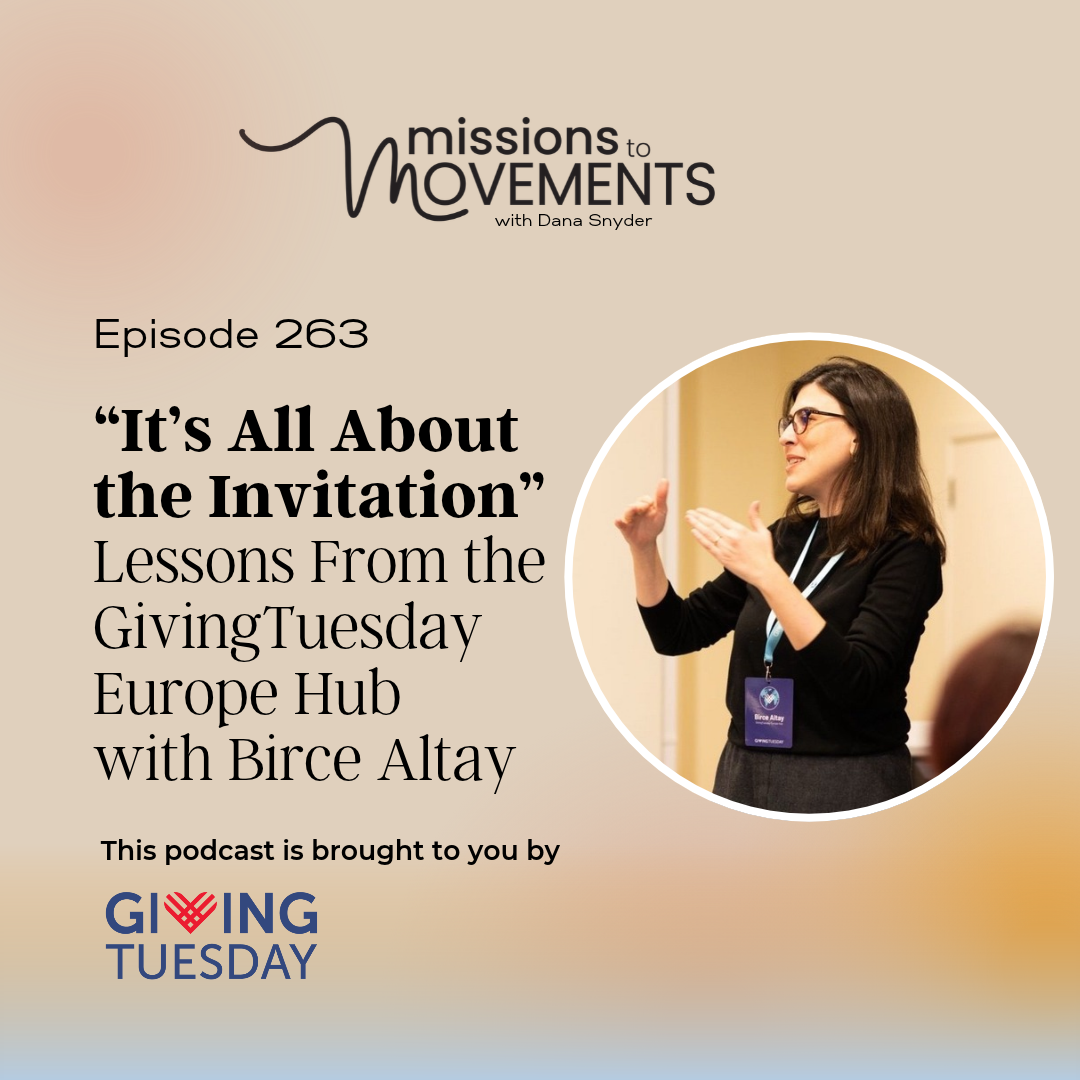
“It’s All About the Invitation” | Lessons From the GivingTuesday Europe Hub with Birce Altay
November 4, 2026

Listen to The Podcast for Marketers Looking to Amplify Their Online Presence
Missions to Movements Podcast
Search the Blog
Blog Categories
I believe positive stories of change can transform our world to be a better place. That’s why I teach nonprofits how to use social media ads to attract potential supporters to their cause and create sustainable giving models by building monthly giving programs for everyone to become a philanthropist.
Hey, I'm Dana Snyder!

Reading Time: 8 minutes
LISTEN ON APPLE | LISTEN ON SPOTIFY
This episode is brought to you by GivingTuesday! GivingTuesday is a global generosity movement that started in 2012 with a simple idea: a day to do good.
“It’s All About the Invitation” | Lessons From the GivingTuesday Europe Hub with Birce Altay
Every year, about ten people sat in one office in Istanbul waiting for GivingTuesday to publish its numbers. They worked at an umbrella organization that strengthens civil society in Turkey, and they wanted the global day of giving in their own country. Around 2020, they reached out to the GivingTuesday team in the United States and asked to join.
One of the people in that office was Birce Altay. She now leads the GivingTuesday Europe Hub, and the lessons from the GivingTuesday Europe Hub she shared with me apply to any nonprofit trying to get more people to show up.
In this episode of Missions to Movements, the first in a special series presented by GivingTuesday, I sat down with Birce in Atlanta, Georgia, right after she landed from Istanbul. We talked about why GivingTuesday looks different in every country, how GivingTuesday France activated more than 12 cities by sharing the work, and why Birce wants Europe measured by how many people take part as well as how much money is raised.
Who Is Birce Altay?
Birce Altay is Director of the GivingTuesday Europe Hub, which connects GivingTuesday country leaders across Europe. She started her career in communications at a digital newspaper in Turkey. Sorting through the news coming in from agencies, she kept seeing civil society organizations doing strong community work that never got covered, and she kept bringing those stories to her lead editor.
Eventually she wanted to do that community work herself. “I began imagining myself doing it rather than telling what has already been done,” Birce told me. She took a communications role at an umbrella organization focused on strengthening civil society in Turkey, which brought her close to philanthropy and giving. About six or seven years later, that organization became the country leader for GivingTuesday Turkey.
In 2024, the GivingTuesday team asked whether she wanted to help build a new Europe Hub. Birce said yes right away. “GivingTuesday was the only thing I wanted to put my energy and time into,” she said.
Why GivingTuesday Looks Different in Every Country
GivingTuesday runs in roughly 110 places around the world, and Birce Altay counts that as 110 different GivingTuesdays. “You can’t take one thing and apply it to another location,” she said. “You just have to make sure it’s localized. It speaks to the realities of that location.”
In Turkey, the team started by deciding that GivingTuesday should be shared and owned by the people celebrating it. From there they mapped out who their stakeholders could be: civil society organizations, corporates, umbrella organizations, and local communities. Birce now spends a large share of her time at the Europe Hub doing the same work at a bigger scale, learning how generosity shows up in each country and region.
The countries also come to GivingTuesday on their own. GivingTuesday rarely approaches an organization and asks it to be a country leader, and there is no money exchanged between GivingTuesday and its leaders. Organizations, groups, and communities that already know about the day take the first step. GivingTuesday calls them “hand raisers,” and what it offers them is a global community, resources, and shared opportunities.
How European Leaders Asked for the GivingTuesday Europe Hub
The Europe Hub was the last regional hub to join GivingTuesday’s global network, and the request came from the leaders themselves. Some GivingTuesday leaders in Europe are celebrating their 11th GivingTuesday this year. They told the global team they wanted an entity that would keep them more connected and sharing more often.
The hubs work on a principle Birce described as “globally connected but locally rooted.” GivingTuesday’s global team still supports leaders everywhere, and the hubs make sure the shared vision lands in each local context.
What leaders asked for varies by country. Germany’s needs are different from Norway’s. Across the region, though, leaders wanted to exchange resources, knowledge, and experience more often, and to learn from each other’s experiments as well as their successes. “You can’t fail on generosity,” Birce told me. For most countries, GivingTuesday is still an experiment, and the hub’s job right now is to create shared opportunities so leaders can try new things and compare notes.
What GivingTuesday Looks Like Across Europe
When I asked Birce to describe the range of what leaders are doing, she started with the streets. In some regions, country leaders celebrate GivingTuesday with events on the ground that bring local communities together. In the UK, leaders time their thought leadership on philanthropy and generosity to coincide with GivingTuesday so the work reaches a wider audience. Charities across the continent also run fundraising campaigns on the day.
One of the examples Birce called most important to her is how well GivingTuesday works in places where civil society is under pressure. “Because GivingTuesday is so flexible, it doesn’t tell you what to be generous about or how to be generous,” she said. In those countries, leaders can shape the day around what their communities need and what is possible, and she has seen them do a lot with that room.
The same flexibility applies to your organization. You get to decide what generosity looks like for the people you serve.
Distributed Leadership: How GivingTuesday France Activated More Than 12 Cities
GivingTuesday runs on a distributed model, and Birce Altay reminds every country leader that they don’t have to carry the day alone. If a leader needs more hands, the message from the hub is to make the ask, or to tell GivingTuesday how it can help.
This year, GivingTuesday France put that into practice. Leaders shared responsibility across more than 12 cities in France, and the results showed up in GivingTuesday’s data and in France’s own reporting. “They were able to reach a lot of new communities. They were able to generate a lot more fundraising,” Birce said. France spread the work out, and both reach and fundraising grew.
I shared Metcalfe’s law with Birce during our conversation: the more people or devices connected in a network, the more something spreads through it. When one person holds the whole campaign, it can only travel as far as that person’s reach. Birce uses France as the example she gives every other leader: “Distribute the leadership, talk to people, and share this big dream that you have with others.”
Why Participation Matters as Much as Money Raised
In May, GivingTuesday’s European leaders met for a summit in the Netherlands to agree on the picture Europe would show the rest of the GivingTuesday world. Europe already has some data, and the Europe Hub does a lot of data work. The leaders landed on participation as the shared priority. They want people to experience GivingTuesday as their own day, celebrated with their own community.
Birce connects this to how Europe thinks about civic life. Europe has a policy concept called active citizenship, backed by plenty of reports and formal mechanisms. “But at the same time, I think what makes people move from their chairs and do something with their community is the generosity,” she said. She calls generosity “the backbone of civic life,” and giving money is one expression of it. Time, talent, testimony, and volunteering all count too.
The Europe Hub’s goal is to show how many people mobilized around something they care about on one specific day, region by region. I mentioned to Birce that people in our sector tend to assume everyone already knows about GivingTuesday. A post I saw on GivingTuesday’s Instagram suggested that in the US, roughly 30% or fewer people give or take part on the day. That leaves a lot of room to grow participation on GivingTuesday and beyond.
What This Means for Your Organization Right Now
I asked Birce which of the lessons from the GivingTuesday Europe Hub could work for a nonprofit anywhere in the world. Her answer was the invitation. We tend to assume people know about GivingTuesday and have decided to sit it out. Birce doesn’t believe that. “Think about your own people and your family,” she said. “When someone invites you to something, then it becomes so natural, and then you want to be a part of it. So it’s all about the invitation. It’s all about the ask.”
Her second piece of advice is to keep it simple. Your GivingTuesday doesn’t need to be one big campaign that draws a massive crowd. Start small, test an idea you’ve been wanting to try, and learn from the result. “If it doesn’t work, you’ll learn something. If it works, great,” Birce said.
Before GivingTuesday on Tuesday, December 1, look at your plan and count how many people you are personally inviting, and how many people on your team or board are doing the same. If that number is small, take France’s lesson and hand the invitation to more people. You can follow Birce’s work through the GivingTuesday Europe Hub and connect with her on LinkedIn.
Frequently Asked Questions
What is the GivingTuesday Europe Hub?
The GivingTuesday Europe Hub is GivingTuesday’s regional hub for Europe, led by Director Birce Altay. It connects GivingTuesday country leaders across Europe so they can share resources, knowledge, and experience more often. European leaders, some of whom have run 11 GivingTuesdays, asked the global GivingTuesday team for the hub themselves. It follows GivingTuesday’s “globally connected but locally rooted” approach.
Who is Birce Altay?
Birce Altay is Director of the GivingTuesday Europe Hub. She began her career in communications at a digital newspaper in Turkey before moving to an umbrella organization that strengthens civil society in Turkey. That organization became the country leader for GivingTuesday Turkey around 2020. In 2024, GivingTuesday invited her to help build the Europe Hub.
How do countries become part of GivingTuesday?
GivingTuesday rarely recruits country leaders. Organizations, groups, and communities that already know about GivingTuesday take the first step and ask to lead it in their country. GivingTuesday calls these leaders “hand raisers,” and there is no monetary relationship between them and GivingTuesday. Birce Altay says GivingTuesday now runs in about 110 places worldwide, each adapted to local conditions.
What is distributed leadership on GivingTuesday?
Distributed leadership means a GivingTuesday country leader shares responsibility for the day with other people, cities, and communities. GivingTuesday operates on a distributed model, and the Europe Hub encourages leaders to ask for help when they need it. At its most recent GivingTuesday, GivingTuesday France used distributed leadership to activate more than 12 cities. According to Birce Altay, France reached new communities and raised more, which showed in GivingTuesday’s data.
What are the main lessons from the GivingTuesday Europe Hub for nonprofits?
Birce Altay’s main lesson from the GivingTuesday Europe Hub is that participation grows through personal invitation, because people join when someone asks them. She also advises nonprofits to start small, since “you can’t fail on generosity,” and every attempt teaches something. GivingTuesday France showed that sharing leadership across more than 12 cities can expand reach and fundraising. European leaders also agreed at their May summit in the Netherlands to measure participation alongside money raised.
Resources & Links
This episode is brought to you by GivingTuesday! GivingTuesday is a global generosity movement that started in 2012 with a simple idea: a day to do good.
This year, on Tuesday, December 1, 2026, join the conversation: share your favorite nonprofit’s campaign, volunteer for a cause you care about, share an act of kindness, or encourage your audience to do the same.
Use #GivingTuesday, tag @GivingTuesday, and visit GivingTuesday.org/Participate to get involved and inspire others!
Connect with Birce on LinkedIn and learn more about GivingTuesday Europe Hub on their website.
The Monthly Giving Builder is the only interactive tool that generates your entire monthly giving program with you, starting at $49.99/month.
My book, The Monthly Giving Mastermind, is here! Grab a copy here and learn my framework to build, grow, and sustain subscriptions for good.
Not sure where to start in building your program? Start with this audit to know where your gap is. Takes 5-10 minutes max, and you’ll know where to start –> Monthly Giving Interactive Audit
Want to make Missions to Movements even better? Take a screenshot of this episode and share it on Instagram. Be sure to tag @positivequation so I can connect with you.
ABOUT THE AUTHOR
Dana Snyder
Dana Snyder is the founder of Positive Equation, creator of the Monthly Giving Builder, a sought-after keynote speaker and workshop facilitator, and the author of The Monthly Giving Mastermind: A Framework to Build, Grow & Sustain Subscriptions for Good. She is also the host of the global nonprofit podcast Missions to Movements and the host of the Monthly Giving Summit, a worldwide event for nonprofit professionals focused on building stronger recurring revenue programs.
Leave a Reply Cancel reply
This site uses Akismet to reduce spam. Learn how your comment data is processed.

ABOUT
BOOK
mastermind
monthly Giving
speaking
media
contact
blog
copyright © positive equation 2022. All rights reserved
→
Enter your email below and I'll send you my 5-Step Framework Podcast Series with strategies you can implement RIGHT away to grow your monthly donors!
Sign up for text updates. By participating, you agree to the terms & privacy policy for automated messages from Positive Equation to the phone number you provide. No consent required to buy. Msg&data rates may apply.
Let's grow your monthly donors, together!
privacy policy

Comments