Start building

Your year-end donors are ready to stay. Give them a way.
Five steps to a monthly giving program

"Monthly Giving Builder made the work feel possible again."
- Sydney Zetune, Executive Director, FEAST



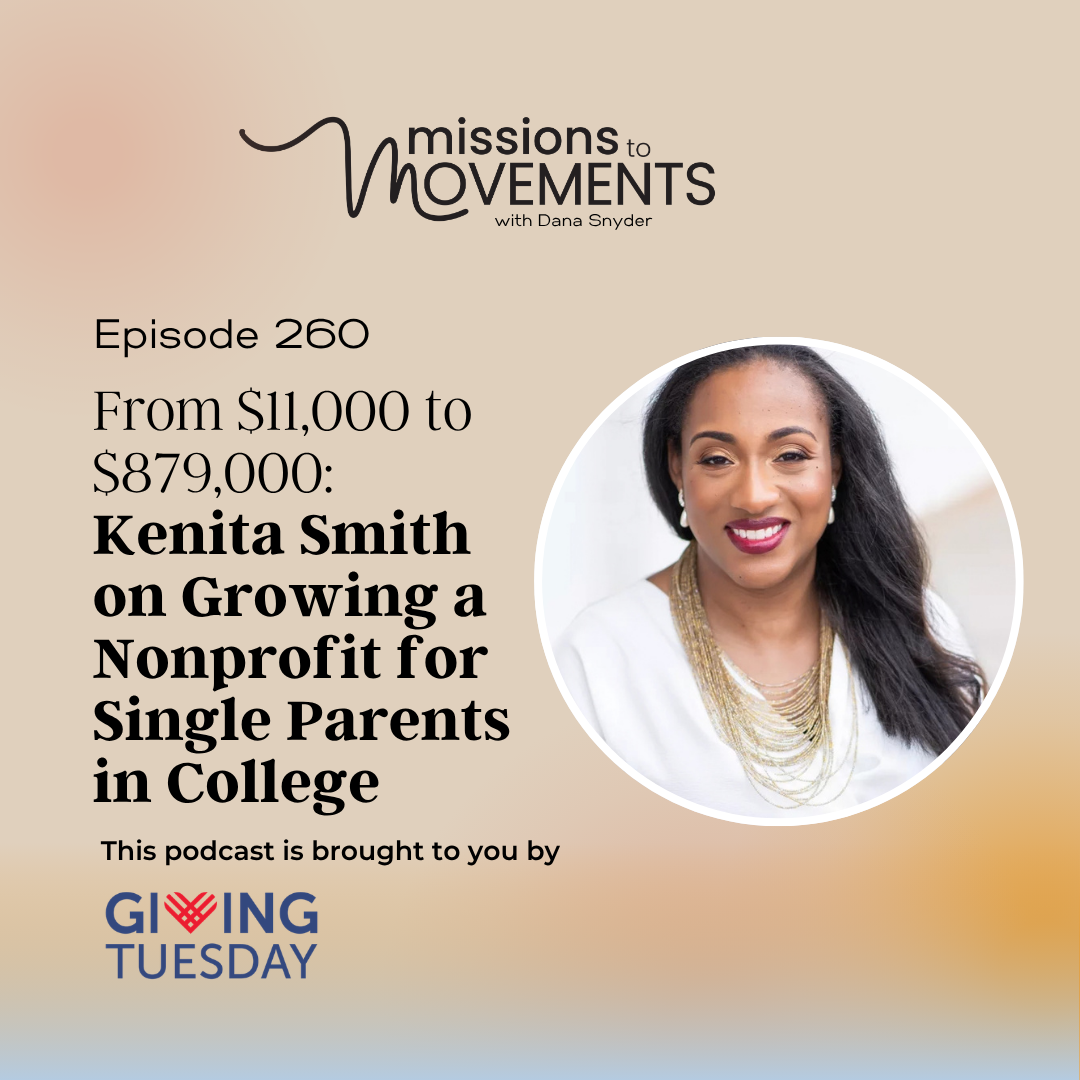
From $11,000 to $879,000: Kenita Smith on Growing a Nonprofit for Single Parents in College
October 14, 2026

Listen to The Podcast for Marketers Looking to Amplify Their Online Presence
Missions to Movements Podcast
Search the Blog
Blog Categories
I believe positive stories of change can transform our world to be a better place. That’s why I teach nonprofits how to use social media ads to attract potential supporters to their cause and create sustainable giving models by building monthly giving programs for everyone to become a philanthropist.
Hey, I'm Dana Snyder!

Reading Time: 9 minutes
LISTEN ON APPLE | LISTEN ON SPOTIFY
This episode is brought to you by GivingTuesday! GivingTuesday is a global generosity movement that started in 2012 with a simple idea: a day to do good.
From $11,000 to $879,000: Kenita Smith on Growing a Nonprofit for Single Parents in College
Kenita Smith was a college sophomore when she had her first son. She transferred to Georgia State University, got into nursing school, and applied for childcare assistance so she could keep studying and raise him herself.
She still remembers the answer word for word: “We would have helped you had you been receiving a diploma or a certificate, but because you’re in a four-year college, we’re not going to assist you.”
She was working toward a degree so she would never need assistance, and the degree was the reason she was turned away. She lived in income-based housing in downtown Atlanta, heard gunshots every day, and kept going. It took her 10 years to finish.
Seventeen years ago, Kenita founded H.O.P.E. Inc. to make sure other student parents didn’t hit the same wall. Her path is a practical case study in growing a nonprofit for single parents from scratch. H.O.P.E. has grown from $11,000 a year to $879,000, raised more than $2.5 million, and helped more than 100 parents walk across the graduation stage.
In this episode of Missions to Movements, recorded in person in Atlanta, Georgia as part of my CEO series, I sat down with Kenita to talk about how she built that growth with no nonprofit background, what she expects from her board, and why she now coaches other small nonprofit founders through her consultancy, Starting My Nonprofit.
Who Is Kenita Smith?
Kenita Smith knew she wanted to go to college when she was six years old. She planned to become a pediatrician, then a nurse practitioner after her son was born, and eventually switched her major at Georgia State University to business administration with a concentration in healthcare. After graduating, she worked as an office manager for a leader who believed in her enough to hand her satellite offices to run.
That job gave her the space to figure out what came next. “After I put out all the fires, I was bored,” Kenita told me. She knew she was a giver, the kind of person who would give the shoes off her feet, and she started sketching a program that would have kept her in school. It offered single parents up to $400 a month in rent assistance and up to $400 a month for childcare, plus free budget coaching, counseling, and support for any other need standing between them and a degree.
She did not know the first thing about starting a nonprofit. She wrote the idea down and showed it to a doctor friend, who told her she had to start it and gave her the seed money for the 501(c)(3) application. It was approved in two months. Today Kenita is founder, president, and CEO of H.O.P.E. Inc. in Atlanta, and through Starting My Nonprofit she coaches founders who are where she was 17 years ago. “I wasn’t sure how it was going to work out, but I knew that I would not stop trying to make it work,” she said.
How Speaking Every Month Grew H.O.P.E. from $11,000 to $879,000
According to the National Council of Nonprofits’ 2025 report, 92% of US nonprofits operate on less than $1 million a year, and 88% run on less than $500,000. H.O.P.E. Inc. started at $11,000. When I asked Kenita Smith what moved it toward $879,000, her answer was relationships, and most of them started with her speaking in front of a room.
“I realized early on that whenever I spoke, we got money,” she said. So she made sure she spoke somewhere every single month. She told the story, talked about the change happening for the parents in the program, and gave people a reason to open doors for her. “I took those doors, and I ran through them.” H.O.P.E. tripled its revenue one year, then kept tripling it.
Kenita has always been told she is a natural public speaker, and she didn’t over-rehearse. She kept a few key points and the same impact story, and let each talk be a little different so she could sound like herself. Every presentation centered on what made H.O.P.E. different from other programs for single parents. That included who it serves: the program supports single fathers with custody of their children as well as single mothers, and many participants are the first in their families to attend college.
Her board backed this from the start. “They felt like that was the secret sauce,” Kenita said. They let her lead with her story and supported her in doing it.
Personal Donor Stewardship That Builds Trust
Speaking brought people in, and the way H.O.P.E. Inc. treated them afterward kept them giving. Kenita Smith met with donors and foundations, showed them the impact, and made sure each one understood what their gift let a student parent accomplish.
“We were never generic,” she said. Donors get handwritten thank-you cards, videos, and phone calls. They hear tangible results and what is happening with the students their money supports. “I built the trust early on,” Kenita told me, and that trust is what helped H.O.P.E. grow.
For a small shop, this kind of stewardship is affordable. A card, a short video from a graduate, or a five-minute call costs very little and tells a donor exactly what their money did.
Should a Nonprofit Founder Go Without a Salary?
Kenita Smith ran H.O.P.E. Inc. full time for several years without paying herself. Every dollar went back into the mission so she could show proof. “I’m a young African American woman, and I want to build trust that this nonprofit is legitimate,” she said. The timing was hard. Her husband at the time was going through cancer treatment, and the family was paying those bills on one income.
What carried them was an unexpected side effect of starting H.O.P.E. Other people wanted to start nonprofits and wanted to know what she knew, so she began consulting and charging for it. That income covered what her family needed. “It certainly was not a picnic,” Kenita said.
Looking back, she would tell other leaders to know their why before making the same choice. If the organization has no operating support and the infrastructure can’t carry a salary yet, going unpaid may be necessary. Kenita did it because she felt she had something to prove, and she sees now that it wasn’t necessarily the case. “Some of the stuff in our head is just, it’s not true,” she said.
I related to this. When I started my business 10 years ago, I asked myself who was going to hire Dana instead of an established brand. I think many women leaders feel they have to prove their worth before anyone will take them seriously, and we make real decisions based on that belief. Kenita’s advice is to know your why, and I would add one more thing: know your worth.
What a Nonprofit Board Should Do: Governance and 100% Giving
Kenita Smith wrote on LinkedIn about what her advisory board gave her that strategy alone could not, so I asked what small, scrappy organizations should be asking of their boards. She started with the basics. “CEOs and founders really need to know what their board is supposed to do,” she said. “They’re the governance of your organization. They’re supposed to support you, yes, but they are supposed to make sure that the organization is on mission.”
She also requires 100% board giving. Kenita has never told her board how much to give, but she asks every member to bring their best. “If the board isn’t going to support the organization, why would a foundation or anyone else?” She openly rejects the give-or-get approach for board members. That arrangement can work for ambassadors or major donors, and she believes a board member should give something personally.
In her view, fundraising is part of every board member’s role, even for people who don’t think of themselves as fundraisers. Board members can open their networks, make introductions, and help bring in money in ways they are comfortable with. Kenita calls this a non-negotiable for any CEO. Without that buy-in, she said, “you struggle, you get burned out.”
Staying Focused on the Barriers, and Taking H.O.P.E. to New Cities
Many nonprofit leaders feel pressure to say yes to every opportunity to keep doors open. Kenita Smith avoided that by knowing exactly who she serves and what stands in their way. The parents in her program look like she did: driven, working, and in school. “These are the key things that kept me in school for 10 years,” she said. “These are the barriers, and I focused on the barriers.” For anything else, H.O.P.E. connects parents to other resources.
When programming expands, the mission gets harder to explain. Kenita’s has stayed specific, and from the outside it is easy to understand exactly what H.O.P.E. does. I told her I think that clarity is a big reason the organization has grown.
H.O.P.E. celebrated its 100th graduate in December, and Kenita wants the next 100 to come from more than one city. Much of the program runs virtually, so it can be replicated. She has researched large cities with high single-parent populations and enough colleges to serve them, and Detroit, Michigan, and Chicago, Illinois, are at the top of her list. People in those cities have asked for a program like H.O.P.E.
Her consultancy, Starting My Nonprofit, began almost as a hobby because people kept asking her questions. She has now worked with 58 CEOs, and she sees how much they value hearing the truth in a form that is “not watered down or commercialized.” Kenita expects it to keep growing alongside H.O.P.E. as more founders see what she has built and ask how she did it.
What This Means for Your Organization Right Now
If your organization is one of the 88% running on less than $500,000 a year, the lessons from growing a nonprofit for single parents carry over to your work, because Kenita Smith’s approach costs time more than money. Start with a speaking calendar. Commit to one talk a month, whether that is a Rotary club, a church group, a chamber lunch, or a panel, and build it around the same impact story and the one thing that makes your program different. Follow up with every person who opens a door.
Then look at your board. Find out whether every member gives personally, and whether each one understands that governance and fundraising are part of the role. If either answer is no, have that conversation before your next board meeting. Finally, write down the two or three barriers your program exists to remove. When a new opportunity comes in, check it against that list before you say yes.
To learn more about Kenita’s work, visit H.O.P.E. Inc. or connect with her through Starting My Nonprofit.
Frequently Asked Questions
What is H.O.P.E. Inc. and who does it serve?
H.O.P.E. Inc. is an Atlanta, Georgia nonprofit founded by Kenita Smith 17 years ago to help single parents stay in college and graduate. The program was designed to provide up to $400 a month in rent assistance and up to $400 a month in childcare assistance, along with free budget coaching and counseling. It serves both single mothers and single fathers who have custody of their children. H.O.P.E. has helped more than 100 parents graduate and has raised over $2.5 million.
How did Kenita Smith grow H.O.P.E. Inc. from $11,000 to $879,000?
Kenita Smith credits relationship building, starting with speaking somewhere every month. She told the same impact story at each talk, focused on what made H.O.P.E. Inc. different, and followed up with the donors and foundations who opened doors. Donors receive handwritten thank-you cards, videos, phone calls, and specific updates on student results. H.O.P.E. tripled its revenue in one year and continued to grow from there.
Should nonprofit board members be required to give?
Kenita Smith, founder and CEO of H.O.P.E. Inc., requires 100% giving from her board, though she does not set a specific amount. She rejects the give-or-get approach for board members and reserves it for ambassadors and major donors. Her reasoning, shared on the Missions to Movements podcast, is that foundations and other donors are unlikely to support an organization whose own board will not support it. She also sees fundraising and governance as core board responsibilities.
Should a nonprofit founder work without a salary?
Kenita Smith ran H.O.P.E. Inc. for several years without a salary to show donors the organization was legitimate, and she supported her family partly through consulting income. She now advises founders to know their why before making that choice. Going unpaid can make sense when an organization lacks operating support or infrastructure. She cautions against doing it only to prove something, which she says was her own reason early on.
What advice does Kenita Smith have for growing a nonprofit for single parents?
Kenita Smith’s advice for growing a nonprofit for single parents is to focus on the specific barriers that keep parents from graduating, such as rent and childcare, and connect participants to other resources for everything else. That focus keeps the mission easy to explain to donors. H.O.P.E. Inc. delivers much of its program virtually, which is why Kenita plans to expand to cities such as Detroit and Chicago. She also coaches founders through her consultancy, Starting My Nonprofit, which has worked with 58 CEOs.
Resources & Links
This episode is brought to you by GivingTuesday! GivingTuesday is a global generosity movement that started in 2012 with a simple idea: a day to do good.
This year, on Tuesday, December 1, 2026, join the conversation: share your favorite nonprofit’s campaign, volunteer for a cause you care about, share an act of kindness, or encourage your audience to do the same.
Use #GivingTuesday, tag @GivingTuesday, and visit GivingTuesday.org/Participate to get involved and inspire others!
Connect with Kenita on LinkedIn and learn more about H.O.P.E. Inc at hopbe.org, or through Starting My Nonprofit.
The Monthly Giving Builder is the only interactive tool that generates your entire monthly giving program with you, starting at $49.99/month.
My book, The Monthly Giving Mastermind, is here! Grab a copy here and learn my framework to build, grow, and sustain subscriptions for good.
Not sure where to start in building your program? Start with this audit to know where your gap is. Takes 5-10 minutes max, and you’ll know where to start –> Monthly Giving Interactive Audit
Want to make Missions to Movements even better? Take a screenshot of this episode and share it on Instagram. Be sure to tag @positivequation so I can connect with you.
ABOUT THE AUTHOR
Dana Snyder
Dana Snyder is the founder of Positive Equation, creator of the Monthly Giving Builder, a sought-after keynote speaker and workshop facilitator, and the author of The Monthly Giving Mastermind: A Framework to Build, Grow & Sustain Subscriptions for Good. She is also the host of the global nonprofit podcast Missions to Movements and the host of the Monthly Giving Summit, a worldwide event for nonprofit professionals focused on building stronger recurring revenue programs.
Leave a Reply Cancel reply
This site uses Akismet to reduce spam. Learn how your comment data is processed.
Next Post
Previous Post

ABOUT
BOOK
mastermind
monthly Giving
speaking
media
contact
blog
copyright © positive equation 2022. All rights reserved
→
Enter your email below and I'll send you my 5-Step Framework Podcast Series with strategies you can implement RIGHT away to grow your monthly donors!
Sign up for text updates. By participating, you agree to the terms & privacy policy for automated messages from Positive Equation to the phone number you provide. No consent required to buy. Msg&data rates may apply.
Let's grow your monthly donors, together!
privacy policy

Comments