

Meet Monthlies Winner: How AART Turned Monthly Donors Into Organizers (Not Just Givers), With Markasa Tucker-Harris
September 16, 2026

Listen to The Podcast for Marketers Looking to Amplify Their Online Presence
Missions to Movements Podcast
Search the Blog
Blog Categories
I believe positive stories of change can transform our world to be a better place. That’s why I teach nonprofits how to use social media ads to attract potential supporters to their cause and create sustainable giving models by building monthly giving programs for everyone to become a philanthropist.
Hey, I'm Dana Snyder!

Reading Time: 7 minutes
LISTEN ON APPLE | LISTEN ON SPOTIFY
This episode is presented by the Monthly Giving Builder, Dana’s step-by-step tool that helps nonprofits build and manage their monthly giving program from start to finish. Sign up here.
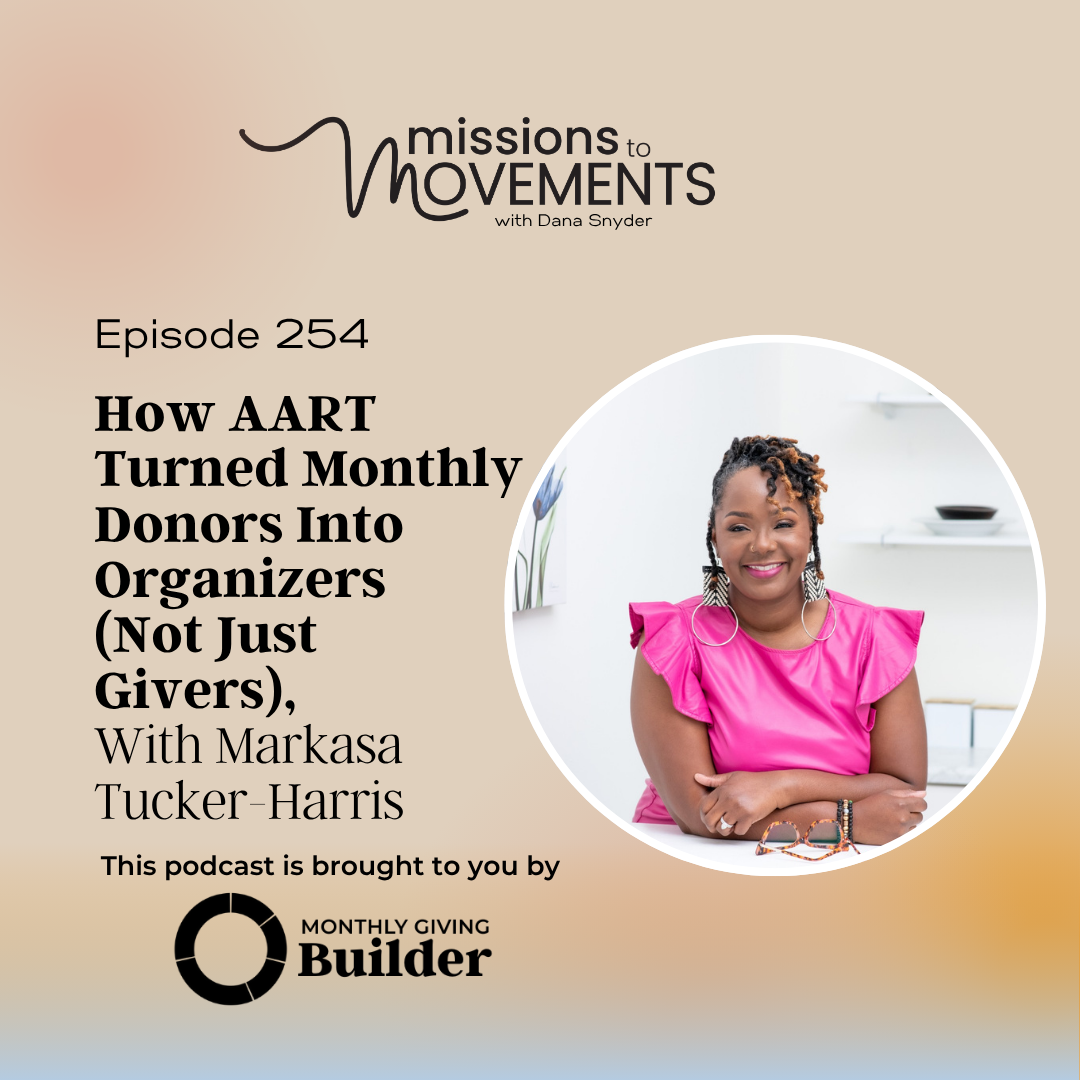
Meet Monthlies Winner: How AART Turned Monthly Donors Into Organizers (Not Just Givers), With Markasa Tucker-Harris
In April 2014, a Milwaukee police officer killed Dontre Hamilton, a Black man, directly across the street from City Hall in broad daylight. Markasa Tucker-Harris describes what happened next as being pulled out of her seat and into purpose. When Dontre was taking his last breath, she was taking some of her first breaths into movement work.
That moment eventually led her to the African American Roundtable, known as AART, where she became director in 2017 and executive director in 2021. Under her leadership, AART built a membership model that changed how the organization funds itself and how its supporters understand their own role in the work.
In this episode of Missions to Movements, I sat down with Markasa Tucker-Harris, Executive Director of AART, winner of this year’s Monthlies award for Strongest Sense of Community, to talk about the membership model for nonprofits her organization built from nothing. One line from AART’s award application has stayed with me since I first read it: “We don’t ask people to support the work. We invite people to be the work.”
Who Is Markasa Tucker-Harris?
Her path into organizing runs through her family history. Her parents came to Milwaukee through the Great Migration from Mississippi, where both were born to sharecropper families on a plantation. She originally studied mass communications, expecting to become a sports reporter, before a job at a daycare exposed her to the daily disparities facing Milwaukee families and children. That experience, combined with the killing of Dontre Hamilton in 2014, pulled her fully into movement work.
She started in police reform organizing before AART shifted toward a more abolitionist approach, one focused on building new systems instead of only dismantling old ones. AART itself began as a project inside a larger, white-led nonprofit, created as a space where Black leaders working across the sector could convene and shape their own priorities. What makes Markasa’s perspective distinct is that she helped grow that internal project into an independent organization with its own funding model built specifically around Black leadership and community ownership.
Why AART Built Membership Instead of a Bigger Donor List
AART organizes on Milwaukee’s far northwest side, closer to the suburbs than the central city, in a part of town where Markasa says organizing had always been transactional. People knocked on doors during election season and disappeared afterward.
The turning point came in 2020. Between COVID and the uprisings that followed George Floyd’s murder, people were flooding into the streets with nowhere to land afterward. “There’s so many people pouring out in the streets, but people don’t have a home,” Markasa said. “They don’t have a place to rest after going into the streets and be with people.” Coalition partners had scattered back to their own organizations and families, and Milwaukee, a mid-sized city without many Black-led citywide movement organizations, needed what Markasa calls a political home.
She sat down with campaign and membership director Devin Anderson and AART’s digital organizer Leah Portman, and the three decided the organization needed its own base. Before that conversation, AART ran a familiar playbook: one-off gifts, a soft monthly ask, and a year-end appeal. Membership changed the pitch entirely. Instead of asking whether someone would give, the ask became an invitation to put a stake in the work itself. “We’re asking you to put your money where you want to see something being built,” she said, and then come help build it.
Inside AART’s Five Membership Tiers
AART’s five tiers build from light engagement toward deep organizing responsibility, and none of them are separated by how much a member gives. Supporting Members stay informed, attend events, and pay dues. Active Members show up regularly and help run things, staffing a registration table or getting flyers into the community. Organizing Members take on real organizing tasks, conduct deeper outreach, and hold one-on-one meetings, effectively becoming an extension of AART’s staff. Member Leaders organize teams, mentor newer members, and are often stipended once funding allows. Campaign Leaders anchor the cohorts running specific campaigns, like AART’s participatory budgeting work and its Feed the Change MKE food justice campaign.
Right now, AART is putting most of its energy into strengthening the Organizing Member tier, which Markasa calls the muscle they’re actively practicing. It’s the point where someone stops simply attending the work and starts carrying a piece of it themselves.
Higher Tiers Don’t Mean Bigger Gifts
Dues at AART are a flat $60 across every tier, and members sometimes cover the cost of membership for someone who can’t afford it. Moving up a tier is about taking on more responsibility. AART is exploring whether certain groups, like advisory board members or business sponsors, should be asked to give more, but the flat structure remains the organization’s starting point.
What Markasa has observed is that the members with the deepest engagement often become the most generous givers on their own. “The member leaders, those who are organizing teams, mentoring other people, holding meetings, they tend to be the ones who will give more,” she said. “I think because they see the value of the work. They’re actually participating, they’re in it.” Members closest to the work can see exactly what their dollars fund, and Markasa’s experience suggests most of them simply want to be invited to give more, rather than asked to prove their commitment first.
What Membership Experiences Actually Look Like
A membership model only works if there is somewhere for people to go once they join, and this is where AART’s Strongest Sense of Community award becomes obvious. The organization keeps a steady rhythm of gatherings tied to campaigns like Feed the Change MKE, along with community brunches, youth organizing events, and a book club. Markasa described a recent gathering built around a food truck alley, a vintage market, and music, with no agenda beyond people being together.
Members also receive swag unavailable to anyone else, and get more direct access to AART’s staff and to Markasa herself. As she put it, “It’s not just us telling and teaching people what to do. We’re learning from our members as well.” Every event still carries some form of invitation, a habit one AART board member summed up by encouraging Markasa to always show up with, as she called it, a pocket full of ask, whether that means inviting someone into membership, asking for a donation, or asking for volunteer time. I love that phrase so much I am stealing it.
Why AART’s Churn Rate Stays Low
Markasa credits AART’s retention to a simple reframe: people don’t leave movements, they lead them. Members who feel ownership over a campaign tend to stay engaged even as their personal capacity changes. She was candid that this comes with real risk, since AART’s most reliable 25 to 30 member leaders are often the easiest people to keep tapping for the next cohort or the next phone bank, which can lead them to overextend themselves at their own expense.
To guard against that, AART builds rest into the model on purpose, encouraging members to step back when needed and proactively reaching out to members who have gone quiet rather than letting them drift away. She referenced Adrienne Maree Brown’s image of birds flying in formation, where the lead position rotates and tired birds fall back to rest before returning to the front. That image stopped me. It reshaped how I think about sustainable leadership, prioritizing rotation over any single person carrying the work indefinitely.
What It Takes Internally to Run a Membership Model
Markasa is candid about what this model actually costs to run. Most of AART’s funding still comes from foundations, followed by organizational and business sponsorships, then members, then non-member monthly donors, and the organization is still building the internal muscle to grow membership’s share of that mix. AART is restructuring staff roles so someone can focus specifically on membership, even without dedicated funding for a full development hire.
Every staff member, including those in logistics and administration, is expected to organize at some level and bring new people into membership over time. Growing membership was also a formal goal in AART’s most recent strategic plan, with communications built around surfacing real member stories, like two members who moved up through the leadership tiers, to help recruit the next cohort.
What This Means for Your Organization Right Now
Markasa’s advice for organizations considering a membership model starts with the actual community need it would address. AART built membership because Milwaukee needed a political home, and the fundraising structure followed from that need.
Bring in outside expertise to help build the model. AART worked with consultant Mary Hooks of Southerners On New Ground in Atlanta, since the organization had never built a membership base before and didn’t need to invent the process from scratch. Put concrete goals and dates into your strategic plan. And once members are in the door, build the structure alongside them by asking how they want to be organized and what would make them want to stay.
Learn more about AART’s work and membership opportunities at aartmke.org.
FAQ: Membership Model for Nonprofits
What’s the difference between a monthly donor and a nonprofit member? A monthly donor gives on a recurring schedule, while a member pays dues in exchange for a defined role, access, and belonging. At the African American Roundtable, members move through five tiers of engagement, with higher tiers involving more organizing responsibility rather than larger financial gifts.
Do nonprofit membership tiers have to be based on giving levels? No, at least not at AART. Markasa built the organization’s five tiers entirely around participation, with flat $60 dues at every level. Deeper engagement tends to produce larger gifts on its own, without a formal pricing ladder attached to each tier.
Is it appropriate to ask volunteers for financial donations? Yes. Markasa Tucker Harris found that AART’s most engaged members, the ones organizing teams and mentoring others, tend to be the organization’s most generous supporters, since they see firsthand exactly what their money funds.
How does AART prevent its members from burning out? AART builds rest into its membership structure by encouraging members to take breaks and by re-engaging members who have gone inactive, rather than relying on the same 25 to 30 member leaders for every campaign. Executive Director Markasa Tucker Harris credits this practice, along with imagery from author Adrienne Maree Brown, with helping AART sustain leadership over time.
How should a nonprofit start building a membership program? Markasa recommends identifying the specific community need a membership model would address, bringing in outside expertise instead of building alone, writing concrete goals with dates into a strategic plan, and designing the member experience together with members themselves.
Resources & Links
This episode is presented by the Monthly Giving Builder, Dana’s step-by-step tool that helps nonprofits build and manage their monthly giving program from start to finish. Sign up here.
Connect with STella! and learn more on their website.
The Monthly Giving Builder is the only interactive tool that generates your entire monthly giving program with you, starting at $49.99/month.
My book, The Monthly Giving Mastermind, is here! Grab a copy here and learn my framework to build, grow, and sustain subscriptions for good.
Not sure where to start in building your program? Start with this audit to know where your gap is. Takes 5-10 minutes max, and you’ll know where to start –> Monthly Giving Interactive Audit
Want to make Missions to Movements even better? Take a screenshot of this episode and share it on Instagram. Be sure to tag @positivequation so I can connect with you.
ABOUT THE AUTHOR
Dana Snyder
Dana Snyder is the founder of Positive Equation, creator of the Monthly Giving Builder, a sought-after keynote speaker and workshop facilitator, and the author of The Monthly Giving Mastermind: A Framework to Build, Grow & Sustain Subscriptions for Good. She is also the host of the global nonprofit podcast Missions to Movements, and host of the Monthly Giving Summit, a worldwide event for nonprofit professionals focused on building stronger recurring revenue programs.
Leave a Reply Cancel reply
This site uses Akismet to reduce spam. Learn how your comment data is processed.
Next Post
Previous Post

ABOUT
BOOK
mastermind
monthly Giving
speaking
media
contact
blog
copyright © positive equation 2022. All rights reserved
→
Enter your email below and I'll send you my 5-Step Framework Podcast Series with strategies you can implement RIGHT away to grow your monthly donors!
Sign up for text updates. By participating, you agree to the terms & privacy policy for automated messages from Positive Equation to the phone number you provide. No consent required to buy. Msg&data rates may apply.
Let's grow your monthly donors, together!
privacy policy

Comments