

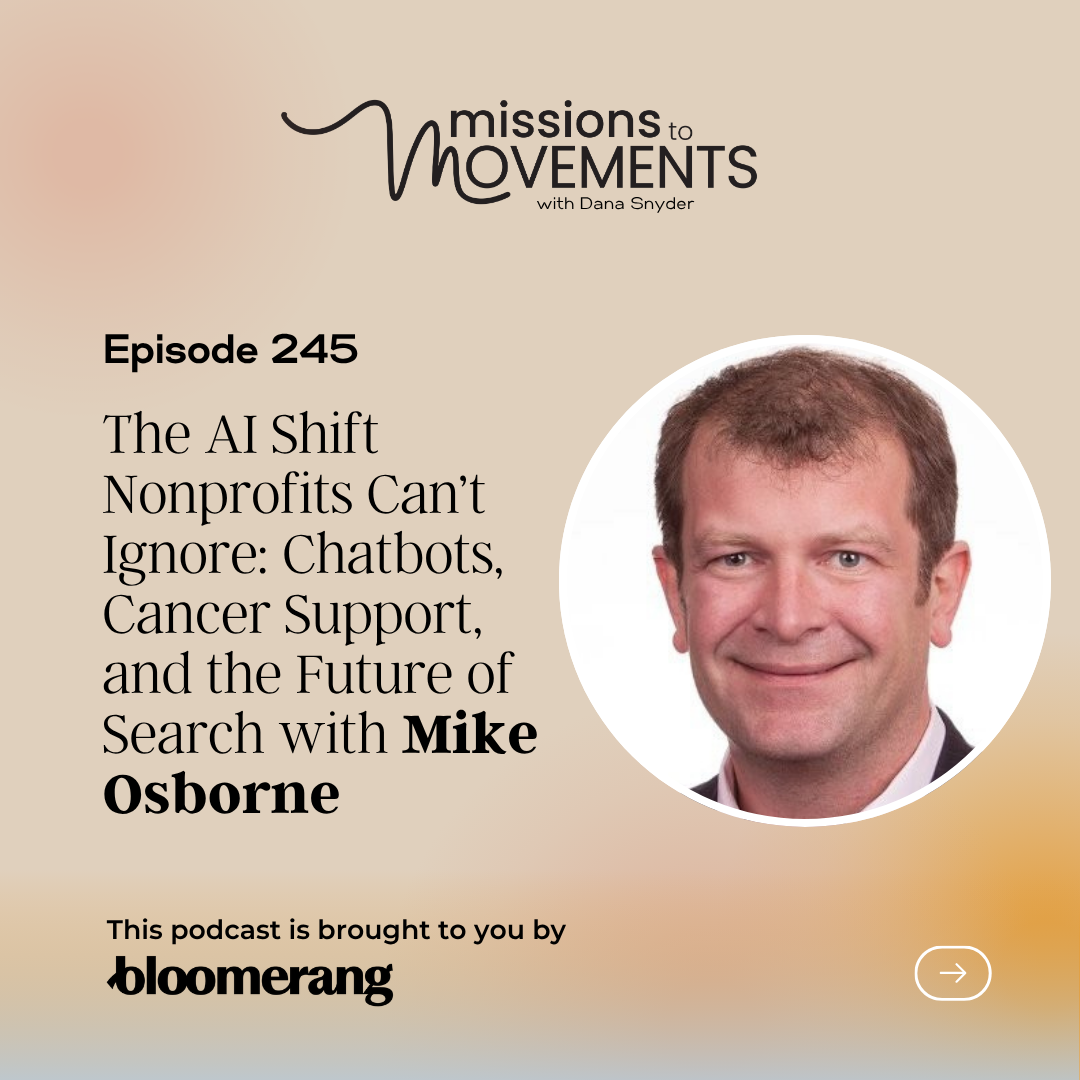
The AI Shift Nonprofits Can’t Ignore: Chatbots, Cancer Support, and the Future of Search with Mike Osborne
July 15, 2026

Listen to The Podcast for Marketers Looking to Amplify Their Online Presence
Missions to Movements Podcast
Search the Blog
Blog Categories
I believe positive stories of change can transform our world to be a better place. That’s why I teach nonprofits how to use social media ads to attract potential supporters to their cause and create sustainable giving models by building monthly giving programs for everyone to become a philanthropist.
Hey, I'm Dana Snyder!

Reading Time: 7 minutes
LISTEN ON APPLE | LISTEN ON SPOTIFY
This episode is presented by the Monthly Giving Builder, Dana’s step-by-step tool that helps nonprofits build and manage their monthly giving program from start to finish. Sign up here.
Ready to walk into EOY with your monthly giving program finally built? Join Dana for a free live webinar and learn the 5-step framework that makes it happen. Register here.
The AI Shift Nonprofits Can’t Ignore: Chatbots, Cancer Support, and the Future of Search with Mike Osborne
One in two people will be impacted by cancer in their lifetime. That number is at the center of everything Cancer Council Victoria does, and it’s the reason Mike Osborne has spent the past three years asking a very practical question: how do you reach and support that many people when you will never have enough cancer nurses to provide one-on-one care to everyone who needs it?
In this episode of Missions to Movements, recorded live at the Microsoft Global Nonprofit Leaders Summit in Seattle, I sat down with Mike Osborne, Chief Information Officer at Cancer Council Victoria, a Melbourne-based charity focused on cancer prevention, early detection, research, and support for those affected by cancer. Mike shared one of the most honest and layered accounts I’ve heard of what it actually looks like to build trusted AI inside a 90-year-old organization, including a discovery about teenagers and chatbots that genuinely surprised his team, and a warning about AI-generated search results that I think every nonprofit communicator needs to take seriously.
Who Is Cancer Council Victoria?
Cancer Council Victoria is part of a federation of cancer councils across Australia. The work spans four areas: cancer prevention, early detection, cancer information and support for people affected by the disease, and research, both funding external cancer research and conducting their own epidemiological work. All of it is supported by fundraisers working toward a vision of a cancer-free future for every Victorian.
As CIO, Mike’s role has two sides. One is the day-to-day work of making sure the organization’s people have the tools and technology to do their jobs safely. The other, and the part that visibly energizes him, is leading the digital transformation that amplifies the impact of the people already doing incredible work in the community: the cancer nurses, the researchers, the financial counselors helping patients through some of the hardest moments of their lives.
Starting With a Vision, Not a Tool
When ChatGPT arrived about three years ago, Mike’s team didn’t move immediately. They spent time mapping where AI could genuinely advance the mission. Mike described keeping a vision board of what’s possible, thinking through the full arc from prevention to early detection to ongoing support, and asking where the technology could meaningfully extend their reach.
The answer kept coming back to the same reality: Cancer Council Victoria could never employ enough cancer nurses to provide individualized support to every person who needs it. So the question became how to use AI to amplify what those nurses do, get trusted information to more people, and connect with the communities who weren’t reaching existing services at all.
That thinking shaped three very different initiatives, each one starting with a specific gap rather than a technology solution.
The Financial Counseling Assistant: Giving Counselors Their Attention Back
When someone is diagnosed with cancer, the financial impact can be immediate and severe. They may not be able to work. They may struggle to pay rent or put food on the table. Cancer Council Victoria’s financial counselors help patients work through that reality, navigating government supports, insurance entitlements, and circumstances that are often complicated and deeply personal.
Before AI, a counselor supporting someone through a difficult call might spend significant time jumping between websites, researching government processes, and tracking down information while the patient waited. That search time pulled focus away from the conversation itself, which is where the actual support happens.
The financial counseling AI assistant, built on Microsoft Azure AI services, addresses that directly. Counselors can now find information quickly and produce follow-up documentation faster, staying present with the person on the other end of the call rather than disappearing into research mode. Internal testing is showing strong accuracy. A public launch is planned for the end of the year, with the goal of routing more straightforward requests through the AI agent so counselors can give their full attention to the most complex cases.
“The magic sauce,” Mike said, “is really good information on a trusted platform.”
The Youth Vaping Chatbot: Meeting People Where They Actually Are
Australia has made real progress driving down smoking rates over the past several decades. Cancer Council Victoria runs Quit, the country’s primary tobacco cessation service. But that progress has stalled as vaping has taken hold, particularly among young people.
When Mike’s team co-designed an intervention for youth, they found something they didn’t expect. Teenagers were far more comfortable opening up to an AI chatbot than calling a phone line staffed by what they perceived to be a judgmental older adult.
“I was quite surprised,” Mike said.
The young people in the co-design process wanted to talk through their situation openly, without fear of being lectured. The phone itself was a barrier. Understanding that changed everything about how the product was built. The cessation tool is being developed as a messaging app, built on platforms young people already use, with tone and language calibrated to feel supportive rather than clinical. The content underneath is grounded in behavioral science-based cessation strategies. The delivery is built around how this particular group actually wants to communicate.
For any nonprofit working with a community that has historically avoided your existing services, this is worth sitting with. The problem is not always awareness of what you offer. Sometimes it is the format of how you offer it.
The Search Traffic Warning Every Nonprofit Needs to Hear
Cancer Council Victoria’s nurse hotline, Mike told me, is often described by the people who use it as “the best service they’d never heard of.” Discoverability has always been a challenge. AI-generated search summaries have made it significantly harder.
The organization has seen a meaningful decline in website traffic as search engines increasingly surface AI-generated answers instead of linking through to the source. For a charity whose reach and fundraising depend on people finding and trusting their content, that is a direct operational problem.
The accuracy concern compounds it. Colleagues in Europe studied AI-generated health summaries appearing in major search engines and found that more than half contained inaccuracies. For an organization providing evidence-based cancer information to people navigating some of the most frightening moments of their lives, inaccurate AI summaries are more than a traffic problem.
Mike was candid that Cancer Council Victoria is still working through how to respond. The approach has to cover two things: reaching people through social media and other channels where they spend their time, and actively ensuring that the high-quality, evidence-based content the organization produces is what AI engines are referencing and surfacing. Traditional SEO optimization is no longer enough on its own. Generative engine optimization, structuring content so AI assistants can accurately extract, cite, and surface it, is now part of the work for any organization whose credibility depends on being the trusted source.
How a 90-Year-Old Organization Builds Internal Trust for AI
Getting a 90-year-old organization to adopt new technology requires more than a rollout plan. Mike’s team took a layered approach that started with making it safe to experiment.
Copilot Chat was enabled as a default tool across the organization, protected behind their information security framework so staff could explore without worrying about sending sensitive data to public AI engines. Today roughly 60% of Cancer Council Victoria staff are active Copilot Chat users, and that number is still growing. The executive team was brought in early to lead from the front. And alongside that broad organizational adoption, Mike’s team has been building the mission-specific tools on Azure AI, grounded in Cancer Council Victoria’s own data and operating within their own secure tenancy.
His advice for a smaller organization with limited resources: start with Copilot Chat, which is free, and find one task that takes meaningful time away from your actual work. Mike built himself a contract review chatbot over half a day that checks agreements against the organization’s security standards and compares them to approved templates. It saves him hours. He built it himself. The barrier to starting is lower than most people think.
What This Means for Your Nonprofit
Every initiative Mike described started the same way: with a specific person who needed something they weren’t getting, and a specific friction point standing between them and the support they needed. The financial counselor pulled away from the conversation to research a government form. The teenager who would never pick up the phone. The cancer patient who couldn’t find accurate information when they needed it most.
AI didn’t generate those problems. It gave Mike’s team new ways to address them. That’s the orientation worth borrowing: start with who is falling through the gaps in your current model, and work backward to the tool that closes them.
The technology is accessible. The harder work is being honest about where your organization’s current model isn’t reaching the people who need it most.
Frequently Asked Questions
What AI tools is Cancer Council Victoria using? Cancer Council Victoria has deployed Copilot Chat across the organization for general productivity, with approximately 60% of staff as active users. For mission-specific work, the team has built a financial counseling AI assistant and a youth vaping cessation chatbot, both developed on Microsoft Azure AI services within the organization’s own secure tenancy.
Why did teenagers prefer an AI chatbot over a phone hotline for vaping cessation? During co-design sessions for Cancer Council Victoria’s Quit youth program, young people said they were significantly more comfortable talking openly with an AI agent than calling a hotline they associated with judgment from older adults. The resulting tool is being built as a messaging app, with tone and language calibrated for a youth audience and content grounded in behavioral science-based cessation strategies.
How are AI-generated search summaries affecting nonprofit website traffic? Cancer Council Victoria has seen a significant decline in website traffic as AI-generated summaries in search engines answer user queries without linking through to source content. Research conducted by European colleagues found that more than half of AI-generated health summaries contained inaccuracies. Nonprofits providing evidence-based information need to invest in generative engine optimization (GEO), structuring their content so AI engines can accurately extract and cite it, alongside traditional SEO and social media outreach.
What is Mike Osborne’s advice for nonprofits beginning their AI journey? Mike recommends starting with Microsoft Copilot Chat, which is available as a free tool, and identifying one specific task that currently takes time away from mission-focused work. Build a simple solution around that task, test it, learn from it, and grow from there. The starting point is smaller than most organizations expect.
Resources & Links
This episode is presented by the Monthly Giving Builder, Dana’s step-by-step tool that helps nonprofits build and manage their monthly giving program from start to finish. Sign up here.
Ready to walk into EOY with your monthly giving program finally built? Join Dana for a free live webinar and learn the 5-step framework that makes it happen. Register here.
Connect with Mike on LinkedIn and learn more about Cancer Council Victoria on their website.
The Monthly Giving Builder is the only interactive tool that generates your entire monthly giving program with you, starting at $49.99/month.
My book, The Monthly Giving Mastermind, is here! Grab a copy here and learn my framework to build, grow, and sustain subscriptions for good.
Not sure where to start in building your program? Start with this $5 audit to know where your gap is. Takes 5-10 minutes max, and you’ll know where to start –> Monthly Giving Interactive Audit
Want to make Missions to Movements even better? Take a screenshot of this episode and share it on Instagram. Be sure to tag @positivequation so I can connect with you
ABOUT THE AUTHOR
Dana Snyder
Dana Snyder is the founder of Positive Equation, creator of the Monthly Giving Builder, a sought-after keynote speaker and workshop facilitator, and the author of The Monthly Giving Mastermind: A Framework to Build, Grow & Sustain Subscriptions for Good. She is also the host of the global nonprofit podcast Missions to Movements, and host of the Monthly Giving Summit, a worldwide event for nonprofit professionals focused on building stronger recurring revenue programs.
Leave a Reply Cancel reply
This site uses Akismet to reduce spam. Learn how your comment data is processed.

ABOUT
BOOK
mastermind
monthly Giving
speaking
media
contact
blog
copyright © positive equation 2022. All rights reserved
→
Enter your email below and I'll send you my 5-Step Framework Podcast Series with strategies you can implement RIGHT away to grow your monthly donors!
Sign up for text updates. By participating, you agree to the terms & privacy policy for automated messages from Positive Equation to the phone number you provide. No consent required to buy. Msg&data rates may apply.
Let's grow your monthly donors, together!
privacy policy

Comments