

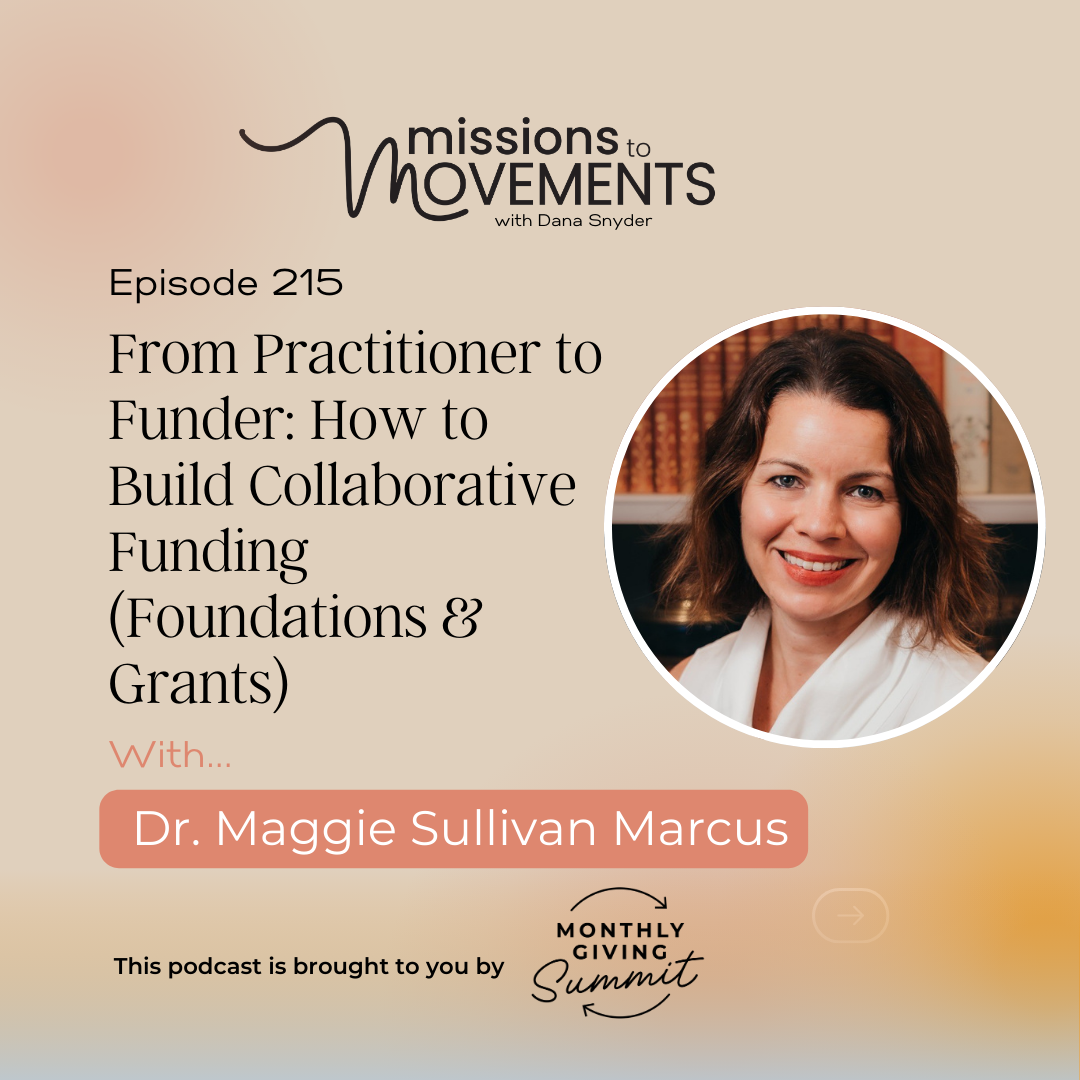
From Practitioner to Funder: How to Build Collaborative Funding (Foundations & Grants) with Dr. Maggie Sullivan Marcus

Listen to The Podcast for Marketers Looking to Amplify Their Online Presence
Missions to Movements Podcast
Search the Blog
Blog Categories
I believe positive stories of change can transform our world to be a better place. That’s why I teach nonprofits how to use social media ads to attract potential supporters to their cause and create sustainable giving models by building monthly giving programs for everyone to become a philanthropist.
Hey, I'm Dana Snyder!

LISTEN ON APPLE | LISTEN ON SPOTIFY
This episode is brought to you by the The Monthly Giving Summit, a free event taking place February 25 – 26 2026! The only virtual summit where nonprofits unite to master monthly giving, attract committed believers, and fund the future with confidence. Learn more and register here.
From Practitioner to Funder: How to Build Collaborative Funding (Foundations & Grants) with Dr. Maggie Sullivan Marcus
What changes when the person writing the check has actually stood at the front of the classroom?
According to Dr. Maggie Sullivan Marcus, everything.
As the Executive Director of the Sullivan Family Charitable Foundation and a former DC Public Schools educator, Maggie brings a perspective that’s still far too rare in philanthropy. She knows what it feels like to manage a classroom, stretch limited resources, and advocate for students whose home languages are too often treated as obstacles instead of assets. And that lived experience fundamentally reshapes how she shows up as a funder.
For nonprofits navigating power dynamics, short-term grants, and the pressure to prove impact on unrealistic timelines, Maggie’s approach offers both relief and a roadmap.
Why Lived Experience Changes Grantmaking
When Maggie sits down with nonprofit leaders, she isn’t just scanning budgets or evaluating logic models. She’s listening through the lens of someone who has done the work herself.
That matters.
Too often, funding decisions are made by people who have never experienced the daily realities of the systems they’re trying to “fix.” Maggie knows firsthand how disconnects can form between central offices, funders, and what actually happens on the ground. That awareness makes her a more empathetic and more effective partner.
It also changes the questions she asks. Instead of defaulting to outcomes framed around what looks good in a report, she leans into nuance: teacher workload, instructional capacity, and whether a proposed solution can realistically be implemented in real classrooms, not just on paper.
The Power of Small, Strategic Investments
One of the clearest examples of Maggie’s philosophy shows up in DC Public Schools’ $2,500 micro-grants for teachers.
On paper, $2,500 might seem insignificant. In practice, it’s transformational.
These micro-grants have funded cooking classes that integrate language learning, better instructional materials for newcomer students, and differentiated instruction strategies that simply weren’t possible before. What stands out isn’t just the creativity, it’s how much impact teachers can generate when they’re trusted with flexible resources.
The lesson here is simple but profound: meaningful change doesn’t always require massive checks. Sometimes it requires funders who are willing to listen, loosen restrictions, and trust educators to know what their students need.
Why Real Change Can’t Happen in 12 Months
One of Maggie’s most candid critiques of traditional philanthropy is its obsession with short timelines.
In education, and in many other social impact spaces, progress doesn’t neatly fit into a 12-month grant cycle. Building a dual-language program, developing a multilingual teacher pipeline, or shifting systems to be more equitable takes years, not quarters.
This is where many funder–nonprofit relationships break down. Funders want fast results. Nonprofits are trying to build something sustainable. Maggie advocates for starting with the long-term goal, then working backward alongside practitioners to understand what needs to happen first.
That mindset shift from “Why can’t this be done in a year?” to “What will it take to do this well?”, changes everything.
Collaboration as a Force Multiplier
Maggie’s work also highlights what’s possible when funders collaborate instead of operating in silos.
Through partnerships involving DC Public Schools, Ensemble Learning, the National Center for Teacher Residencies, and multiple foundations, Maggie helped support a multilingual educator pipeline that no single organization could have funded alone. The benefits were mutual: nonprofits had fewer reports to write, funders learned together, and resources went further.
For nonprofits, there’s an important takeaway here. Asking, “Who else funds this work?” isn’t just a polite question—it can be a strategic one. Funders often want to know who their peers are in a space, and sometimes they’re waiting for someone to connect the dots.
And sometimes, as Maggie points out, you have to be the one willing to step into that connector role.
What Trust-Based Philanthropy Actually Looks Like
“Trust-based philanthropy” gets talked about a lot. Maggie brings it down to earth.
At its core, it’s about relationships. It’s about funders being humble enough to say, “I may have the money, but you have the expertise.” It’s about creating space for honesty when things don’t go as planned—and not punishing organizations for that honesty.
It also means multi-year funding.
Multi-year grants give nonprofits something incredibly valuable: time. Time to stop constantly reapplying. Time to put their heads down and do the work. Time to build something that actually lasts.
For Maggie, trust-based philanthropy isn’t a trend. It’s a recognition that power dynamics exist and that funders have a responsibility to use their power in ways that strengthen, rather than strain, the organizations they support.
Building Better Funder Relationships Starts With Being Human
One of the most refreshing parts of Maggie’s approach is how simple it is.
She talks about getting to know people as people asking about their backgrounds, their interests, even their least favorite fruit. She prioritizes in-person connection when possible and encourages both funders and nonprofit leaders to use conferences as relationship-building opportunities, not just learning events.
Behind every grant decision is a human being with experiences, values, and motivations. The more we acknowledge that, the stronger and more sustainable our partnerships become.
A Different Way Forward for Nonprofits and Funders
Maggie’s work reminds us that philanthropy doesn’t have to be transactional, rushed, or disconnected from reality. When educators become funders, empathy increases. When trust replaces control, impact deepens. And when collaboration replaces competition, everyone wins, especially the communities we’re trying to serve.
For nonprofits looking to move beyond one-off grants and toward real partnership, this is the work: build relationships, think long-term, and don’t be afraid to invite funders into a more honest, human way of working together.
Resources & Links
Connect with Dr. Maggie Sullivan Marcus on LinkedIn and learn more about the Sullivan Family Charitable Foundation on their website.
Already have a monthly giving program? The Mini Monthly Giving Mastermind starts in January and is just for you.
Register now for the FREE Monthly Giving Summit on February 25-26th, the only virtual event where nonprofits unite to master monthly giving, attract committed believers, and fund the future with confidence.
My book, The Monthly Giving Mastermind, is here! Grab a copy here and learn my framework to build, grow, and sustain subscriptions for good.
Join The Sustainers, my Slack community for nonprofit professionals growing and scaling a recurring giving program.
Want to make Missions to Movements even better? Take a screenshot of this episode and share it on Instagram. Be sure to tag @positivequation so I can connect with you.
Leave a Reply Cancel reply
This site uses Akismet to reduce spam. Learn how your comment data is processed.

ABOUT
BOOK
mastermind
monthly Giving
speaking
media
contact
blog
copyright © positive equation 2022. All rights reserved
Enter your email below and I'll send you my 5-Step Framework Podcast Series with strategies you can implement RIGHT away to grow your monthly donors!
Sign up for text updates. By participating, you agree to the terms & privacy policy for automated messages from Positive Equation to the phone number you provide. No consent required to buy. Msg&data rates may apply.
Let's grow your monthly donors, together!
privacy policy

Comments