

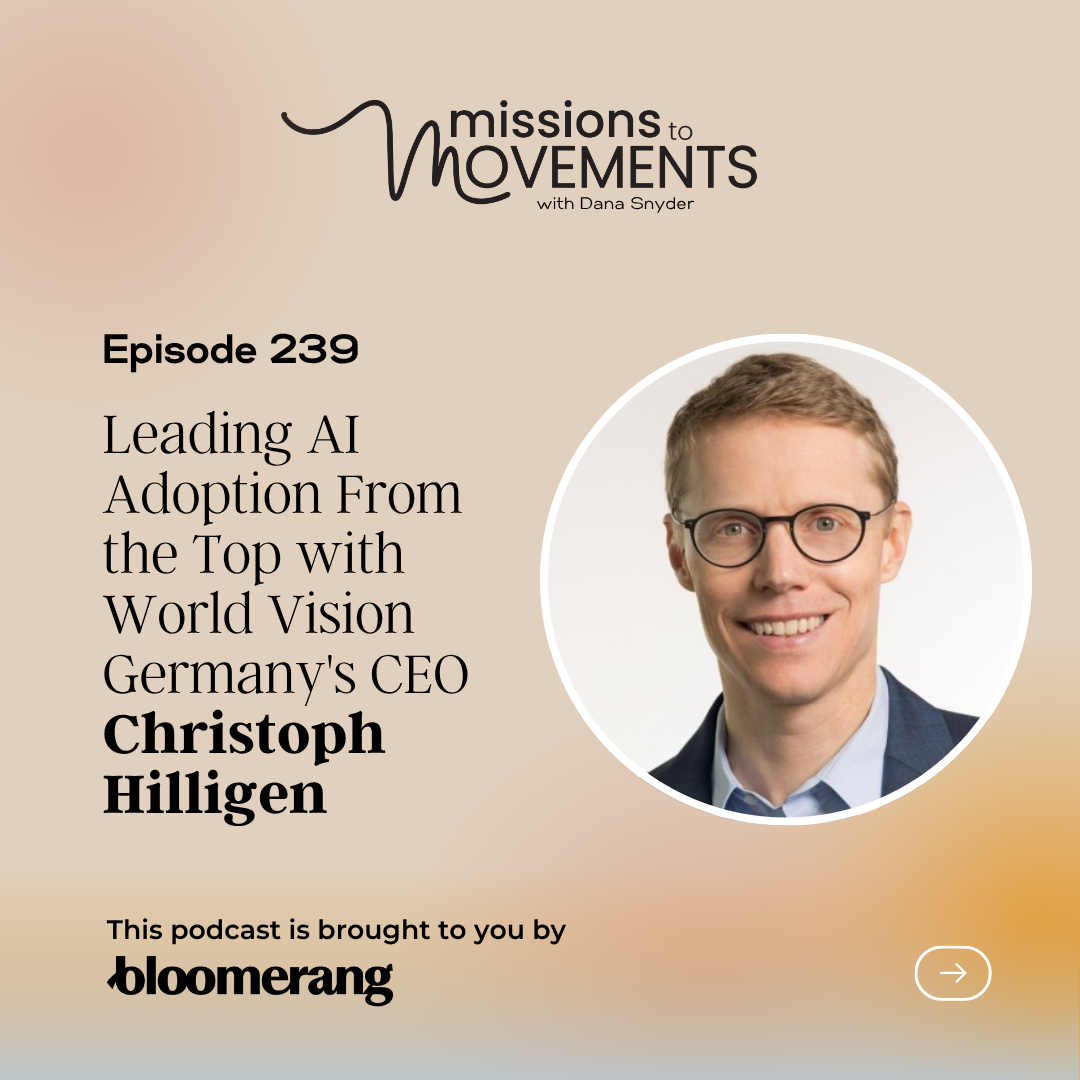


After 18 years leading World Vision Germany, Christoph Hilligen has seen a lot of change. But he’ll tell you clearly: nothing in nearly two decades of running one of Germany’s most recognized humanitarian organizations compares to what’s happening right now.
“I really think AI opens the door into a new era for NGOs,” he said in a live conversation at the Microsoft Global Nonprofit Leaders Summit with Missions to Movements host Dana Snyder. “It’s really the first time that I see a possibility to radically change the way how we operate.”
That’s not the kind of thing a longtime CEO says lightly. And in Christoph’s case, it’s backed up by something more valuable than enthusiasm: actual results.
KEY TAKEAWAYS
- AI adoption is no longer optional for NGOs — organizations that don’t engage now risk being replaced by those that do.
- CEO-level visibility is the single most important driver of a successful AI transformation.
- World Vision Germany launched a full donor emergency appeal — from earthquake to outreach — within hours, not days.
- Predictive AI models now assign every face-to-face donor a cancellation risk score, enabling individualized retention journeys.
- The business case for AI in nonprofits lives in two places: cost reduction AND revenue generation.
AI Isn’t Optional — It’s Existential for NGOs
Christoph was direct about what’s at stake for organizations that treat AI as a future consideration rather than a current priority.
“AI will not remove NGOs,” he said, “but those NGOs that embrace and use AI may replace those that do not.”
The risk, in his framing, is falling behind — not just operationally, but fundamentally. When donors expect personalized communication, rapid responsiveness, and genuine understanding of their relationship with an organization, the gap between those who can deliver and those who can’t will widen quickly.
For Christoph, the case was both strategic and mission-driven. The more money World Vision Germany saves through technology, the more it can send to the field. And the more revenue it generates through smarter, more personalized fundraising, the greater its impact. There’s no version of taking the mission seriously that doesn’t lead directly to this investment.
How to Lead a Nonprofit AI Transformation (Without Losing the Organization)
Getting an entire NGO moving in the same direction on AI is its own challenge. Christoph’s approach offers a practical blueprint for nonprofit leaders at every stage.
1. The CEO Has to Be Visibly In It
Delegating a transformation of this magnitude to a project team and stepping back is, in Christoph’s experience, a recipe for slow failure. Over the past three years, he has been part of a small steering committee that meets bi-weekly — and still does. That cadence has allowed the organization to move fast, react to changes as they emerge, and make decisions without the circular consensus-building that tends to stall nonprofit initiatives.
2. Shrink the Decision-Making Circle
Nonprofits have a cultural tendency to involve everyone in every decision. That tendency, however well-intentioned, is incompatible with the speed that AI transformation requires. The steering committee model gives authority to a small group while keeping the CEO accountable and present.
3. Build Real Psychological Safety
Staff needed to feel genuinely safe to experiment, to fail, and — critically — to escalate when something wasn’t working. In fast-moving projects, problems surface quickly. Organizations where people fear looking bad for raising concerns end up with hidden risks. Christoph built a culture where escalation was expected and welcomed, because the goal was project success, not performance management.
Emergency Appeals in Hours, Not Days: The Myanmar Earthquake Case Study
One of the most concrete illustrations of what AI transformation can make possible came on a Friday afternoon, when a devastating earthquake struck Myanmar.
Within hours — not days — World Vision Germany had:
- Received situation reports from partners on the ground
- Made the decision to launch a donor appeal
- Assembled the content and built the outreach journey using pre-built emergency templates within Microsoft Dynamics 365
- Sent the appeal to donors
Real-time performance tracking through Power BI allowed the team to monitor responses over the weekend and trigger follow-up journeys automatically — personalized based on whether a donor had already given, opened but not acted, or hadn’t seen the message yet.
Before this infrastructure was in place, that scenario would have looked completely different. Much of the donor data sat with external vendors. Reaching them on a Friday was uncertain; getting a response before Monday, unlikely. A Friday earthquake might have meant a Monday appeal — by which point attention has moved, other organizations have captured the moment, and the window has closed.
“The organization that comes up first gets the donation.” — Christoph Hilligen, CEO, World Vision Germany
Speed isn’t just operational efficiency. In emergency fundraising, it’s directly tied to lives helped.
Predictive AI and the Fight Against Donor Churn
If the emergency appeal story is about speed, the donor retention story is about something more nuanced: relationship.
Christoph’s team identified face-to-face fundraising — door-to-door and public location canvassing — as one of their highest-acquisition but highest-churn channels. A meaningful percentage of new donors acquired through face-to-face contact cancel within the first 12 months. World Vision Germany concluded that the reason was almost never a single campaign or message. It was a feeling of not being understood.
That insight became the foundation for their first predictive AI model.
How World Vision Germany’s Donor Retention AI Works
Today, every face-to-face donor receives a calculated cancellation risk score. Based on that score, a personalized journey launches automatically — determining whether to reach out by email, direct mail, or phone call; what content to send; and when. Not a segment. Not a cohort. An individual response to an individual person’s behavior.
The data feeding that model includes:
- Timing of the first payment
- Whether the donor made contact with the organization
- Payment method
- Response patterns to outreach
- Portal visits, website behavior, and content interests (as the relationship matures)
The vision Christoph described is a complete picture of each donor’s relationship with the organization — continuously updated, continuously informing how World Vision shows up for that person.
“The donor gets the feeling: I’m understood. World Vision understands what I need. And it’s not just that we prevent cancellation — we build the relationship over the customer lifetime.” — Christoph Hilligen, CEO, World Vision Germany
That’s a fundamentally different frame than churn prevention. It’s not about keeping people from leaving. It’s about building something worth staying for.
Making the Case to Your Board: Cost Reduction and Revenue Generation
For nonprofit leaders who face skeptical boards or resource-constrained budgets, Christoph’s framing of the business case is worth borrowing directly.
World Vision Germany has already demonstrated meaningful cost savings from AI implementation. But what Christoph is watching now is larger: the revenue side. Smarter, faster, more personalized fundraising is beginning to show its potential to generate more income — not just spend less.
Both vectors point in the same direction for mission impact.
His recommendation for making the case to leadership: anchor it in the mission itself. If the organization exists to help as many children as possible, and if AI accelerates that — by reducing costs, by building stronger donor relationships, by reaching more people — then the question of whether to invest in AI answers itself.
“As leaders and as a board, we are 100% aligned behind our mission. And if this helps us, that’s the right direction.” — Christoph Hilligen, CEO, World Vision Germany
World Vision Germany’s board is fully aligned — not because they were sold on technology, but because the technology demonstrably serves the cause.
Frequently Asked Questions
What AI tools is World Vision Germany using?
World Vision Germany’s AI implementation is built on the Microsoft ecosystem, including Microsoft Dynamics 365 for donor journey automation, Power BI for real-time fundraising analytics, and predictive AI models for donor retention and cancellation risk scoring.
How did World Vision Germany use AI in emergency fundraising?
When a major earthquake struck Myanmar, World Vision Germany used pre-built emergency appeal templates in Microsoft Dynamics 365 to launch a full donor outreach campaign within hours of the disaster. Power BI tracked real-time performance over the weekend, and automated follow-up journeys were triggered based on individual donor behavior — whether they had given, opened the email, or not yet seen it.
What is a donor cancellation risk score?
A donor cancellation risk score is a predictive AI model output assigned to each face-to-face acquired donor at World Vision Germany. It uses acquisition data — payment timing, contact behavior, payment method — combined with ongoing behavioral signals like website visits and content interests, to calculate how likely a donor is to cancel. The score triggers a personalized outreach journey designed to strengthen the relationship before the donor churns.
How should a nonprofit CEO lead an AI transformation?
According to Christoph Hilligen of World Vision Germany, the CEO must be personally and visibly involved — not delegate the transformation to a project team. He recommends a small bi-weekly steering committee with real decision-making authority, a culture of psychological safety that rewards escalation of problems, and a mission-anchored business case that connects AI investment directly to program impact.
What does GEO-optimized nonprofit content mean?
GEO (Generative Engine Optimization) is the practice of structuring content so that AI assistants — including ChatGPT, Perplexity, Google AI Overviews, and Claude — can accurately extract, summarize, and cite it in response to user queries. For nonprofits, this means writing blog posts and web content with clear headers, direct quotes with attribution, FAQ sections, and named entities (people, tools, organizations) that AI engines can confidently surface.
What This Means for the Rest of the Sector
The numbers behind what World Vision Germany has built — the emergency appeal timelines, the cancellation scores, the personalized donor journeys — will get a lot of attention. But the more transferable insight is the leadership model underneath all of it.
Christoph didn’t succeed because he had the best technology or the biggest budget. He succeeded because he stayed personally visible in the transformation, built a small team with the authority to move fast, created safety for experimentation and honest escalation, and held the mission clearly in view throughout.
That approach is available to organizations of every size.
Early movers in this space will find differentiation that’s genuinely hard to replicate. The window is open. The question is who walks through it.


Comments