

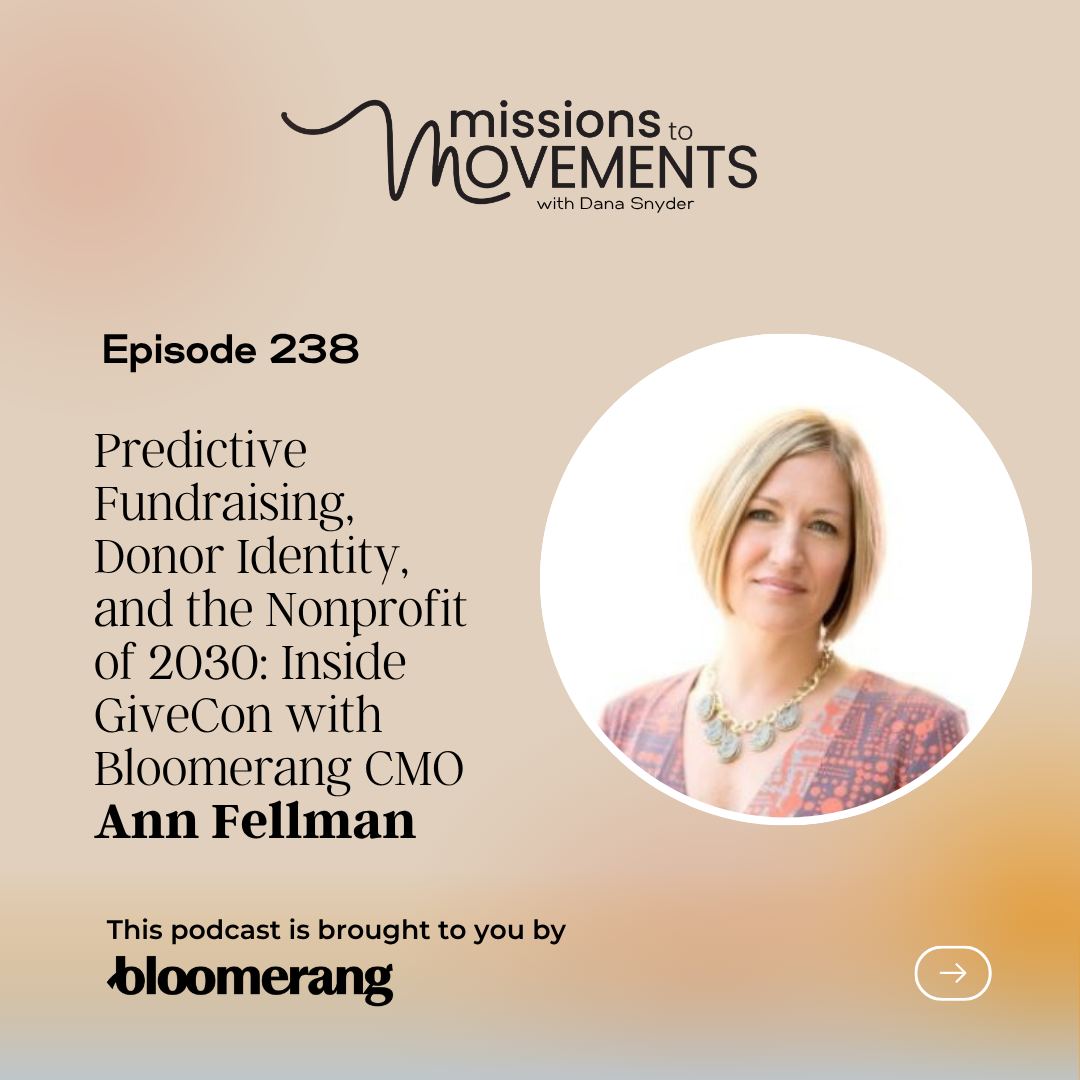


Imagine wrapping up one of the biggest conferences in nonprofit fundraising, arriving home after days of back-to-back conversations, dropping your suitcase at the door, and sitting down for a podcast recording before you’ve even unpacked. That’s exactly what Bloomerang CMO Ann Fellman did when she joined Dana Snyder on Missions to Movements, fresh off the closing moments of GiveCon 2026.
What came out of that conversation is a remarkably candid picture of where nonprofit fundraising is right now: what leaders are struggling with, what data is surprising them, and what a strong nonprofit fundraising strategy for end-of-year actually looks like heading into the second half of the year.
KEY TAKEAWAYS
- Monthly donors give more, stay longer, and are worth far more than their monthly gift amount suggests — the average monthly donor sticks around for eight years.
- Donors want more email than you think. Bloomerang’s Giving Signals Report shows a clear gap between how often nonprofits communicate and how often donors actually want to hear from them.
- AI can help nonprofits do more with less — but only when there’s a human reviewing, verifying, and making the final call.
- The best time to do donor story collection and end-of-year prep is June and July, not October.
- Bloomerang’s new predictive donor intelligence and conversational reporting tools make it easier than ever for any team member to act on data without being a reporting expert.
- The mindset shift that changes everything: every interaction with a donor is a decision. Start making them.
The Energy That’s Hard to Replicate in a Webinar
GiveCon is Bloomerang’s annual gathering for nonprofit fundraisers, and by Ann’s description, it’s unlike most sector conferences. Attendees call it a space to finally be “with their people”: colleagues who speak the same language, wrestle with the same donor spreadsheets, and understand why the right email subject line can keep you up at night.
Over lunches, Ann was already in the trenches with attendees, brainstorming content ideas. One exchange about creating a “day in the life of a water bottle” at a summer camp for donors captures the creative spirit she’s championing. It’s not about polished corporate storytelling. It’s about finding the tangible, human, sometimes funny moments that donors actually connect with.
“These are my people. I’m back at the office and I can’t have these types of conversations there.”
— GiveCon attendee, as shared by Ann Fellman
For those who haven’t yet made it to an in-person fundraising gathering, Ann’s practical advice is simply this: get it in your budget. Plan for it in your next fiscal year. The ROI on community isn’t always a line item, but the clarity and momentum you bring home from these rooms is hard to put a number on.
Mark your calendars: GiveCon 2027 is headed to Atlanta, May 3–6. Consider this your earliest heads-up.
The Three Themes That Dominated Every Hallway Conversation
1. AI, But Always with a Human in the Loop
It shouldn’t surprise anyone that artificial intelligence was woven into nearly every session and side conversation at GiveCon. What was more nuanced, though, was how Bloomerang is approaching it. Ann was clear: AI for nonprofits is not about automation replacing relationships. Fundraising is a relationship business. Full stop.
Bloomerang’s guiding principle is “human in the loop,” meaning AI can help surface insights, handle administrative weight, and even help preserve institutional knowledge through staff turnover, but a human must review, verify, and ultimately decide. For smaller nonprofits with lean teams, that’s both a practical safeguard and a philosophical commitment to the relational heart of their work.
Why this matters for your org: Nonprofits with high staff turnover often lose critical donor knowledge when someone leaves. AI tools that help capture and surface that history can be genuinely transformative, not as a replacement for people, but as institutional memory.
2. Monthly Giving, Seen Through the Lens of Lifetime Value
Monthly giving was the second major current running through GiveCon, and for good reason. But the reframe Ann and Dana offered is worth sitting with: most nonprofit teams look at a monthly donor and see a $10 or $25 monthly gift. That framing undersells the relationship dramatically.
When you account for the average monthly donor’s retention rate of roughly eight years, that same $25/month donor represents more than $3,200 in lifetime value, before any one-time gifts they may make on top of their recurring commitment.
“That’s a mid-level donor. That’s also the possibility of a legacy gift. That’s also someone who might start volunteering and become one of your most committed advocates.”
— Dana Snyder
Ann reinforced this with the lens of donor identity, particularly for younger donors. Gen Z and Millennial supporters are increasingly choosing organizations that reflect their personal values and provide a sense of belonging. They don’t just want to give; they want to feel genuinely connected to the mission. That means engaging monthly donors should feel less like a transaction and much more like an ongoing relationship.
The acquisition cost calculation also shifts when you think in lifetime value. A donor who stays for eight years is absolutely worth spending hundreds of dollars to acquire. That math rarely gets made explicitly, but it should.
3. Email: Send More Than You Think You Should
This one consistently surprises people the first time they hear it. Bloomerang’s Giving Signals Report found a revealing gap: nonprofits believe they’re doing robust multichannel communication, leaning heavily into social media. Their donors, however, are asking for more email.
Not less. More.
Ann’s recommendation: email more than feels comfortable. The fear of overwhelming donors often keeps organizations under-communicating. But donors don’t wake up thinking about your nonprofit every day. Your job is to gently, consistently put your mission in front of them. Even if an email goes unopened, your name in an inbox is a touchpoint. It’s a nudge. It keeps you top of mind.
Dana shared a personal example: it took seeing a brand’s fourteenth promotional email before she finally made a purchase. She wasn’t annoyed; she just finally had a moment to act. Unsubscribes, Ann added, are a feature, not a bug. They help you know exactly who is genuinely engaged.
What to Be Doing Right Now (June and July) for End-of-Year Success
Summer is often treated as a slower stretch in the fundraising calendar. Ann and Dana both push back on that framing. These months are exactly when you build the foundation that makes fall and December feel less frantic and more strategic.
Ann’s top recommendation: do your story collection now. Reach out to a handful of donors, not five hundred, just a few, and have actual conversations. What do they care about? What language do they use to describe your mission? What made them give in the first place?
Then, before you finalize your end-of-year appeal, run it by your “friendlies”: a small group of trusted supporters who can tell you honestly whether the message lands. Does this resonate? Is anything missing? Ann does this routinely with marketing campaigns, and it consistently produces more human, effective messaging than what any internal team produces in isolation.
A note on approval processes: If your executive director tends to “sanitize” donor appeals into more corporate-sounding copy, Ann’s advice is to A/B test. Let the data make the argument. Emotional storytelling outperforms polished institutional language, and now you’ll have the proof to back it up.
Inside Bloomerang’s New AI-Powered Tools
Ann also shared two significant product announcements from Bloomerang that are directly relevant to any team thinking about smarter, more proactive fundraising.
Predictive Donor Intelligence (Launching July 2026)
Through a new partnership with Dayteral, Bloomerang is launching a native predictive intelligence integration that will surface six key donor signals directly within the platform. Think of it as a dashboard that answers the questions fundraisers ask themselves every day: Who is at risk of lapsing? Who is ready for an upgrade ask? Who should I call today?
The shift this enables is from reactive fundraising, digging through reports when you have time, to proactive, signal-driven relationship management. Every donor record already contains these signals. The new integration simply surfaces them in a way that’s actionable without requiring a data analyst on staff.
Conversational Reporting
Also newly launched: a natural language reporting feature that lets any team member ask questions in plain English and get a report in return. “Show me my lapsed donors from this year.” “Who has given more than $1,000 in the last three years?” No more waiting for the one staff member who knows how to run queries.
The practical unlock here is data democratization. When an executive director can pull a donor list on their own in thirty seconds, or a major gifts officer can instantly see upgrade opportunities, the entire team moves faster and with more confidence.
The Mindset Shift That Changes Everything
As the conversation wound down, Dana asked Ann for the one thing she’d want to send to every nonprofit leader who wasn’t in the room at GiveCon. Her answer was deceptively simple.
“Every interaction with a donor is a decision you have to make. Stop waiting. Start deciding. Start taking those steps forward, even if they’re small ones.”
— Ann Fellman, CMO, Bloomerang
It’s easy to stay in planning mode: keep refining the strategy, wait for the perfect system, delay the ask until everything is ready. Ann’s challenge is to resist that instinct. The tools are becoming more powerful. The data is more accessible. But none of it replaces the human decision to actually pick up the phone, send the email, or make the ask.
The nonprofits that thrive heading into 2030 won’t be the ones with the biggest budgets or the most sophisticated tech. They’ll be the ones making deliberate, human decisions with their donors every single day.
The Bottom Line for Your Nonprofit Right Now
Whether you’re mid-fiscal-year or just starting to think about year-end appeals, the throughline from this conversation is consistent: the best nonprofit fundraising strategy for end-of-year is one that starts with relationships. Donor stories collected in June, conversations that shape your October appeal, monthly giving programs that compound over years, not months.
AI, predictive tools, and conversational reporting can all accelerate that work. But they amplify the human strategy. They don’t replace it.
Check out Bloomerang’s Giving Signals Report for the full data behind these themes, and if you’re not already planning for GiveCon 2027 in Atlanta, start now.


Comments